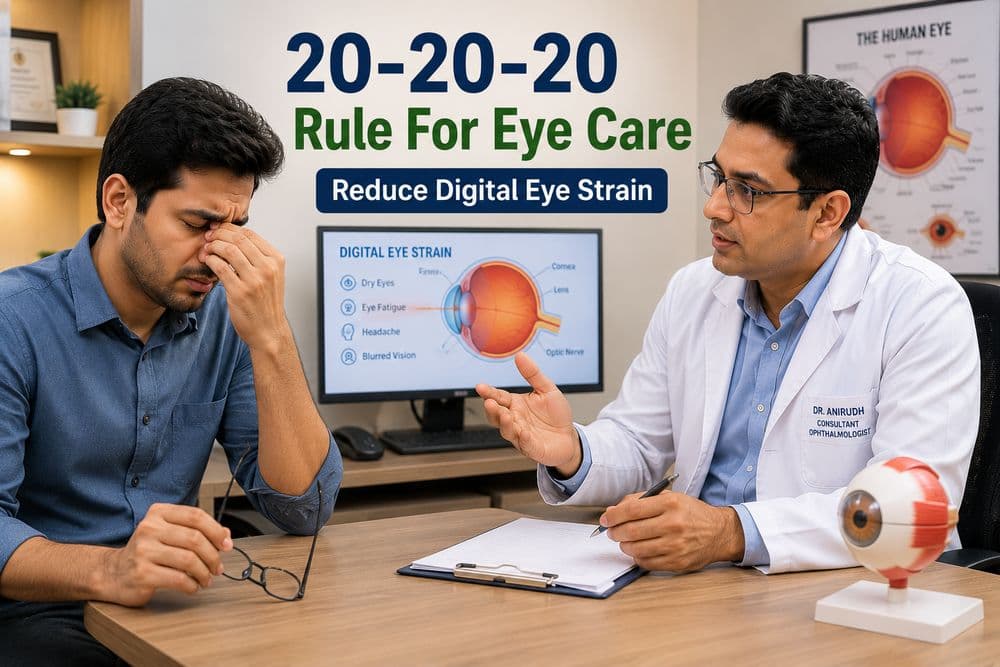
What Is the 20-20-20 Rule for Eye Care? A Simple Habit to Reduce Digital Eye Strain
Medically reviewed by Dr. Nikhil Singh, Anaesthesia, MBBS, MD
Last reviewed: 24 Aug 2026 · How we review health content
Introduction
In today's digital world, many people spend several hours each day looking at smartphones, laptops, tablets, and computer screens. While technology has become an essential part of work, education, and entertainment, excessive screen exposure can place significant stress on the eyes.
Symptoms such as eye fatigue, dryness, blurred vision, and headaches have become increasingly common. To help reduce digital eye strain, eye care professionals often recommend a simple practice known as the 20-20-20 Rule.
This easy habit takes only a few seconds but may help provide relief for people who spend long hours in front of screens.
What Is the 20-20-20 Rule?
The 20-20-20 rule is a simple eye relaxation technique.
It recommends:
Every 20 minutes, look at something 20 feet away for at least 20 seconds.
The goal is to give the eye muscles a short break from continuous close-up focusing.
Why Is the 20-20-20 Rule Important?
When using digital devices, the eyes continuously focus on objects at a close distance.
Over time, this may lead to:
- Eye strain
- Dry eyes
- Blurred vision
- Headaches
- Difficulty focusing
Regular visual breaks may help reduce the workload on the eye muscles.
How Does Screen Time Affect the Eyes?
When looking at a screen for long periods:
Reduced Blinking
People tend to blink less frequently while using digital devices.
Reduced blinking may contribute to:
- Dry eyes
- Irritation
- Burning sensation
- Eye discomfort
Continuous Focusing
The eye muscles remain engaged for prolonged periods when focusing on nearby screens.
This may result in:
- Eye fatigue
- Temporary blurred vision
- Difficulty shifting focus
Increased Visual Stress
Poor lighting, screen glare, and improper viewing distance can further increase eye strain.
Benefits of the 20-20-20 Rule
Helps Reduce Eye Fatigue
Short breaks may help relax eye muscles that have been focusing on screens.
May Improve Comfort During Screen Use
Many people report reduced discomfort after incorporating regular visual breaks.
Encourages Blinking
Looking away from screens may naturally increase blinking and improve eye moisture.
Supports Better Focus
Brief breaks may help improve concentration and reduce visual fatigue during long work sessions.
Who Should Follow the 20-20-20 Rule?
The rule may be beneficial for:
- Office workers
- Students
- Gamers
- Graphic designers
- Programmers
- Content creators
- Anyone spending long hours on digital devices
How to Practice the 20-20-20 Rule
Step 1
Work normally for 20 minutes.
Step 2
Look away from the screen.
Step 3
Focus on an object approximately 20 feet away.
Step 4
Maintain focus for at least 20 seconds.
Step 5
Resume your work.
Repeating this throughout the day may help reduce digital eye strain.
Additional Tips for Healthy Eyes
Maintain Proper Screen Distance
Keep screens approximately an arm's length away whenever possible.
Adjust Screen Brightness
Avoid excessive brightness or glare.
Use Adequate Lighting
Good room lighting may reduce eye strain.
Stay Hydrated
Proper hydration supports overall eye health.
Get Regular Eye Checkups
Routine eye examinations help detect vision problems early.
Signs of Digital Eye Strain
You may be experiencing digital eye strain if you frequently notice:
- Dry eyes
- Eye fatigue
- Blurred vision
- Headaches
- Burning sensation
- Difficulty focusing
- Neck and shoulder discomfort
These symptoms often improve after rest.
When Should You See an Eye Doctor?
Consider consulting an eye specialist if:
- Symptoms occur regularly
- Blurred vision persists
- Eye discomfort becomes severe
- Headaches increase during screen use
- Vision changes develop
An eye examination can help identify any underlying issues.
Can the 20-20-20 Rule Improve Vision?
The 20-20-20 rule does not permanently improve eyesight or eliminate the need for glasses.
However, it may help reduce temporary eye strain associated with prolonged screen use.
Conclusion
The 20-20-20 rule is a simple and practical habit that may help reduce digital eye strain in today's screen-focused world. By taking a 20-second break every 20 minutes and looking at an object 20 feet away, individuals can give their eyes a chance to relax and recover.
Combined with healthy screen habits and regular eye examinations, this technique can support better visual comfort and eye health.
Related reading
Top Anesthesiologist doctors in Gorakhpur on Zospital
Explore professional profiles and available appointment options.
- Book appointment

Dr Karanvir Singh Sidhu
Anesthesiologist
Lucknow
Verified•4.8 - Book appointment
Aveline Pascual Jerome, MD
Anesthesiologist
Ajmer
5 - Book appointment
Dr. Vivek Kumar Sharma - Laser & Advanced Laparoscopy Surgeon In Ajmer
Anesthesiologist
Ajmer
4.7 - Book appointment
Dr.Jay M. Panchal
Anesthesiologist
Ahmedabad
5 - Book appointment

Amit T. Darnule, MD
Anesthesiologist
Agra
4.9 - Book appointment
Dr Rajat Arora
Anesthesiologist
Agra
Have More Questions?
Find quick answers to common questions about our services, appointments, and patient care.
The 20-20-20 rule suggests looking at something 20 feet away for 20 seconds after every 20 minutes of screen use.
It helps reduce digital eye strain and allows eye muscles to relax.
No. It helps reduce eye fatigue but does not permanently improve vision.
Anyone who spends long hours using computers, mobile phones, tablets, or other digital devices.
It may help by encouraging blinking and reducing continuous screen exposure.
Every 20 minutes during screen use.
Yes. Children who spend significant time on screens may also benefit from regular visual breaks.
Dry eyes, headaches, blurred vision, burning sensation, and eye fatigue are common symptoms.

“Your Health, Our Priority. Your Voice, Our Guide”
Dr. Nikhil Singh
Anaesthesia, MBBS, MD
Private hospitals in Gorakhpur on Zospital
Prefer a private option? These hospitals in Gorakhpur list their doctors and take bookings.
- Shankar Eye and Maternity Clinic- Best eye hospital | Best eye surgeon | Eye and Maternity clinic in Gorakhpur
- Trimurti Hospital - Dr. Sanjeev kumar Singh
- Shakuntala Hospital
Related Articles

WHO Digital Health Guidelines Explained
WHO Digital Health Guidelines focus on safe, accessible, and effective use of technology in healthcare. Learn how digital health is transforming modern medical systems.

WHO Guidelines on Screen Time for Children Explained
WHO has released screen time guidelines for children to support healthy growth, sleep, and mental well-being. Learn the recommended limits by age.

Why Hospitals See More Kidney Stone Cases During Summer
Kidney stone cases often increase during summer due to dehydration and excessive fluid loss through sweating. Learn why hot weather raises the risk and how to protect your kidney health.

Written by Dr. Nikhil Singh
Anaesthesia, MBBS, MD
Last reviewed: 24 August 2026
Medical Disclaimer
The content provided on Zospital is for general informational and educational purposes only. It is not intended as a substitute for professional medical advice, diagnosis, or treatment. Always seek the advice of your physician or other qualified healthcare provider with any questions you may have regarding a medical condition. Never disregard professional medical advice or delay in seeking it because of something you have read on this website. If you think you may have a medical emergency, call your doctor or emergency services immediately.
Are you a doctor or run a clinic or hospital?
Patients across India are searching Zospital right now. Get a free profile with reviews, timings and direct WhatsApp bookings.