Cashless vs Reimbursement Claim in Health Insurance: A Guide
Medically reviewed by Dr. Nikhil Singh, Anaesthesia, MBBS, MD
Last reviewed: 24 Aug 2026
When a family member is hospitalised, the last thing you want to worry about is paperwork and payments. Understanding how your health insurance policy pays the hospital bill is crucial. In India, there are two primary methods for settling a claim: cashless and reimbursement. The choice between a cashless vs reimbursement claim in health insurance can significantly impact your out-of-pocket expenses and the administrative burden during a stressful time.
Recent regulations by the Insurance Regulatory and Development Authority of India (IRDAI) in 2024 have dramatically changed the landscape, introducing strict timelines and policyholder-centric initiatives like 'Cashless Everywhere'. This guide explains the mechanism of both claim types, the documents required, and the rights you now have as a policyholder.
New IRDAI Claim Timelines (2024)
Timelines are mandated by the IRDAI Master Circular dated May 29, 2024. The 'Bank Rate' is the prevailing rate published by the Reserve Bank of India.
- Cashless Pre-Authorisation Decision — Within 1 Hour
- Final Authorisation at Discharge — Within 3 Hours
- Reimbursement Claim Settlement — Within 30 Days
- Penalty Interest on Reimbursement Delay — 2% Above Bank Rate
Rates shown are as per the Insurance Regulatory and Development Authority of India (IRDAI) (2024) and are subject to periodic revision. Always verify the latest approved rates on the official source.
Understanding the Two Claim Types: Cashless vs. Reimbursement
A health insurance policy provides financial cover for medical expenses, but how that money reaches the hospital is what defines the claim type. Your experience at the hospital billing counter will be very different depending on which route you take.
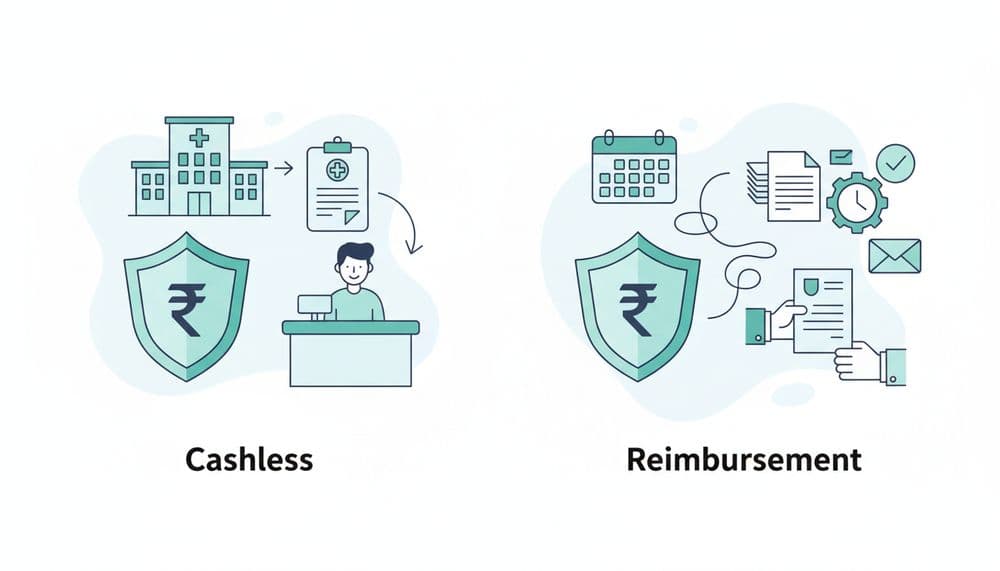
A Cashless Claim is one where the insurance company, through its Third-Party Administrator (TPA), pays the approved hospital bill directly to the hospital. You, the policyholder, are only required to pay for expenses not covered by your policy (like non-admissible consumables) or costs that exceed your policy's sub-limits. This is generally possible only at hospitals that are part of the insurer's 'network'.
A Reimbursement Claim involves you paying the entire hospital bill yourself first. After discharge, you gather all original bills, reports, and a claim form, and submit them to your insurer. The insurer then verifies the documents and repays (reimburses) you for the covered expenses. This method is used for treatment at non-network hospitals or when a cashless request is not feasible.
The Cashless Claim Process: Speed and Convenience
The cashless process is designed to be smooth and reduce the financial burden on the policyholder at the time of hospitalisation. The IRDAI's 2024 rules have made this process significantly faster.
The workflow is straightforward:
1. Admission & Pre-Authorisation: At the time of admission to a network hospital, the hospital's insurance desk submits a pre-authorisation request form to your insurer or TPA. This form details the patient's condition, the proposed treatment plan, and an estimated cost.
2. Insurer's Decision: The insurer must review this request and communicate its decision – whether approved, denied, or requiring more information – within a mandatory one-hour timeframe.
3. Discharge & Final Bill: Once the patient is cleared for discharge, the hospital sends the final bill and discharge summary to the insurer. The insurer then has a maximum of three hours to give the final authorisation for payment.
The key advantage is that you do not need to arrange for a large sum of money to settle the bill. The primary documents you need to provide to the hospital are your health insurance card (or policy number) and a valid photo ID. The hospital and insurer handle the rest of the paperwork.
The 'Cashless Everywhere' Initiative
A major development is the 'Cashless Everywhere' facility, introduced by IRDAI in January 2024. This allows policyholders to seek cashless treatment even at hospitals that are not part of their insurer's direct network.
To use this facility:
• For planned treatments, you must inform your insurer at least 48 hours before admission.
• For emergency treatments, you must inform the insurer within 48 hours of admission.
The hospital must have at least 15 beds and be registered under the Clinical Establishments Act. Upon being notified, your insurer is obligated to coordinate with the hospital and attempt to provide a cashless facility, following the standard 1-hour and 3-hour approval timelines.
However, this is not an absolute guarantee. The success of 'Cashless Everywhere' depends on the non-network hospital agreeing to the insurer's payment terms and rates for the specific procedure. If the hospital refuses to cooperate, you will have to pay the bill first and file a reimbursement claim.
The Reimbursement Claim Process: When It's Your Only Option
You will need to file a reimbursement claim in several situations: if you receive treatment at a non-network hospital and 'Cashless Everywhere' is not availed or is refused by the hospital; if your initial request for cashless authorisation is denied for any reason; or if you simply choose to pay upfront.
The reimbursement claim process puts the initial financial and administrative burden on you. The steps are as follows:
1. Intimate the Insurer: Inform your insurer about the hospitalisation as per your policy's terms, usually within 24-48 hours of admission.
2. Pay the Bill: Settle the entire hospital bill out-of-pocket at the time of discharge. Be sure to collect all original documents.
3. Submit Documents: Fill out the insurer's claim form and attach all required original documents. This typically includes the discharge summary, final bill, itemised bill, payment receipts, all medical reports, and pharmacy bills with prescriptions. You usually have 15 to 30 days from discharge to submit these.
4. Claim Settlement: The insurer must process your claim and either pay or reject it within 30 days of receiving the last necessary document. If they delay, they are liable to pay interest.
- Crucial Document Checklist for Reimbursement:
- Duly filled and signed Claim Form
- Original Hospital Discharge Summary
- Original final bill and itemised bill
- Original payment receipts
- Original investigation reports (X-rays, blood tests, etc.)
- Original pharmacy bills with prescriptions
- Doctor's consultation notes
- Copy of ID proof and a cancelled cheque for payment transfer
- Medico-Legal Certificate (MLC) or FIR in case of an accident
MECHANISM: How a Reimbursement Claim is Calculated
Understanding how an insurer arrives at the final payable amount is key to managing expectations. The reimbursement amount is not always the same as the total hospital bill. Deductions are made for non-covered items and for expenses that exceed policy sub-limits. Let's walk through an example.
Illustrative Scenario:
A policyholder, Mr. Sharma, is hospitalised for 4 days. His policy has a Sum Insured of ₹5 lakh and a sub-limit on room rent of ₹5,000 per day.
Hospital Bill Breakdown:
• Total Bill: ₹1,50,000
• Room Rent: ₹7,500 per day for 4 days = ₹30,000
• Surgery Charges: ₹80,000
• Medicines & Diagnostics: ₹25,000
• Non-Payable Consumables (gloves, masks, etc.): ₹15,000
Claim Calculation by the Insurer:
1. Start with the Total Bill: ₹1,50,000
2. Deduct Non-Payable Items: The policy does not cover the ₹15,000 for standard consumables. Amount becomes ₹1,50,000 - ₹15,000 = ₹1,35,000.
3. Apply Room Rent Sub-Limit: Mr. Sharma's policy covers only ₹5,000 per day for the room. His actual cost was ₹7,500 per day. The excess amount is not payable.
- Eligible Room Rent: ₹5,000/day x 4 days = ₹20,000
- Actual Room Rent: ₹30,000
- Deductible Amount: ₹30,000 - ₹20,000 = ₹10,000
- Amount after room rent deduction: ₹1,35,000 - ₹10,000 = ₹1,25,000.
Final Payout:
The insurance company will approve and reimburse ₹1,25,000. Mr. Sharma will have to bear the remaining ₹25,000 (₹15,000 for non-payables + ₹10,000 for excess room rent) from his own pocket. Note that some policies also apply proportionate deduction on other charges if a room rent sub-limit is breached, which could further reduce the payable amount.
ENTITLEMENT: Your Rights Under IRDAI's 2024 Mandates
As a policyholder, you are protected by regulations that hold insurers accountable for timely service. The most significant of these is the IRDAI Master Circular on Health Insurance Business, dated May 29, 2024. This document consolidates previous rules and gives you specific, legally enforceable rights.
Know your entitlements:
1. Right to Fast Cashless Authorisation: When a hospital requests pre-authorisation for a cashless claim, the insurer must provide a decision (approve, query, or deny) within one hour.
2. Right to Swift Discharge: At the time of discharge, the insurer must provide the final authorisation for payment within three hours of receiving the final bill from the hospital.
3. Right to Penalty on Insurer for Delay: If the insurer fails to meet the three-hour discharge timeline, and the hospital charges you for the extra time spent waiting (e.g., additional room rent), the insurer is legally obligated to pay these extra charges. Importantly, this payment must come from the insurer's own shareholder funds, not from your policy's Sum Insured.
4. Right to Timely Reimbursement: For a reimbursement claim, once you have submitted all the necessary documents, the insurer must settle or reject the claim within 30 days.
5. Right to Interest on Delayed Reimbursement: If the insurer fails to settle your reimbursement claim within the 30-day window, it must pay you interest on the approved claim amount. The interest rate is set at 2% above the current bank rate for each day of delay.
These timelines are not suggestions; they are regulatory mandates. If an insurer does not comply, you have the right to file a grievance with the insurer and escalate it to the IRDAI.
The Role of the Third-Party Administrator (TPA)
You will often interact with a Third-Party Administrator (TPA) instead of the insurance company directly. A TPA is a separate company licensed by IRDAI that acts as an intermediary. Insurers hire them to manage the administrative aspects of health insurance claims.
A TPA's functions include issuing health cards, maintaining a network of hospitals, providing customer support, and, most importantly, processing cashless and reimbursement claims on behalf of the insurer. They are responsible for collecting documents and verifying them against the policy terms.
However, it is critical to understand the limits of a TPA's power. According to IRDAI regulations, including the Master Circular of May 2024, a TPA cannot reject a claim on its own. The final decision to repudiate (reject) any claim must be made by the insurance company itself, typically through an internal Claims Review Committee. If a TPA communicates a rejection, it is doing so on the explicit instruction of the insurer. Therefore, any appeal or grievance against a claim denial should be directed at the insurance company.
Disclaimer
All information on this page is for educational purposes only and is based on regulations and data as of 2024. It is not intended as a substitute for professional financial or medical advice. Health insurance policies and their terms can be complex. Please consult a qualified insurance advisor to understand the specifics of your policy and make decisions appropriate for your personal situation. Always refer to your policy documents for the exact terms and conditions of your coverage.
More insurance guides
Related guides from our India health insurance hub:
- Health Insurance Portability in India: How to Switch Insurers Without Losing Benefits
- Health insurance claims and portability in India: all guides
- Health insurance in India: the complete guide
Frequently Asked Questions
What happens if the hospital delays submitting the final bill for a cashless claim?
The insurer's 3-hour timeline for final authorisation only begins after it receives the final bill and discharge summary from the hospital. If the hospital's administrative process is slow, the delay is on the hospital's end. It's advisable to follow up with the hospital's insurance desk to ensure they send the documents to the insurer promptly after the doctor finalises the discharge.
Can a TPA reject my health insurance claim?
No, a TPA cannot unilaterally reject a claim. As per IRDAI (Third Party Administrators - Health Services) Regulations, 2016, and reinforced by the May 2024 Master Circular, the final authority to approve or repudiate a claim lies with the insurance company. The insurer's internal Claims Review Committee must approve any rejection. The TPA only processes the claim as per the insurer's guidelines.
Why would a cashless claim request be denied?
A cashless request might be denied for several reasons: the information provided in the pre-authorisation form may be insufficient; the ailment might not be covered under the policy (e.g., it falls within a waiting period or is a specific exclusion); or the policy limit may have been exhausted. If denied, you can still proceed with the treatment, pay the bill, and file for a reimbursement claim.
What are 'non-payable items' in a health insurance claim?
Non-payable items, or non-admissible consumables, are medical supplies that are typically not covered by a standard health insurance policy. This includes items like gloves, masks, cotton, syringes, bandages, and other administrative or convenience charges. IRDAI publishes a standard list of such items, and they are deducted from the final claim amount.
Is there a deadline to submit documents for a reimbursement claim?
Yes, most policies specify a deadline for submitting the claim form and all original documents. This is typically between 15 to 30 days from the date of discharge. While IRDAI encourages insurers to be considerate if there's a valid reason for a delay, it is always best to submit your documents well within the stipulated timeframe to ensure smooth processing.
How does cashless vs reimbursement claim health insurance work for emergency hospitalisation?
For emergencies, the process is similar but with adjusted timelines for intimation. For cashless, you can get admitted to a network hospital and the insurance desk will initiate the process. For reimbursement or 'Cashless Everywhere', you must inform the insurer within a specified period, usually 24 to 48 hours after admission, so they can begin their process.
Related
- Health insurance claims and portability in India
- Health insurance in India: the complete guide
- Government health schemes in India: a guide
- Treatment cost in India: a complete guide
Medical Disclaimer
The information provided in this article is for general informational and educational purposes only. It is not intended as a substitute for professional medical advice, diagnosis, or treatment. Always seek the advice of your physician or other qualified healthcare provider with any questions you may have regarding a medical condition. Never disregard professional medical advice or delay in seeking it because of something you have read in this article.
Written by
Top Anesthesiologist doctors in Lucknow on Zospital
Verified specialists you can book in minutes.
- Book appointment

Dr. Sanni Deyol Gautam
Anesthesiologist
Lucknow
4.8 - Book appointment

Dr Karanvir Singh Sidhu
Anesthesiologist
Lucknow
4.8 - Book appointment

Dr Harpreet Kaur
Anesthesiologist
Lucknow
4.8 - Book appointment

Dr. Akshat Trivedi
Anesthesiologist
Lucknow
4.5 - Book appointment

Aveline Pascual Jerome, MD
Anesthesiologist
Ajmer
5 - Book appointment
Dr. Vivek Kumar Sharma - Laser & Advanced Laparoscopy Surgeon In Ajmer
Anesthesiologist
Ajmer
4.7
Have More Questions?
Find quick answers to common questions about our services, appointments, and patient care.
The insurer's 3-hour timeline for final authorisation only begins after it receives the final bill and discharge summary from the hospital. If the hospital's administrative process is slow, the delay is on the hospital's end. It's advisable to follow up with the hospital's insurance desk to ensure they send the documents to the insurer promptly after the doctor finalises the discharge.
No, a TPA cannot unilaterally reject a claim. As per IRDAI (Third Party Administrators - Health Services) Regulations, 2016, and reinforced by the May 2024 Master Circular, the final authority to approve or repudiate a claim lies with the insurance company. The insurer's internal Claims Review Committee must approve any rejection. The TPA only processes the claim as per the insurer's guidelines.
A cashless request might be denied for several reasons: the information provided in the pre-authorisation form may be insufficient; the ailment might not be covered under the policy (e.g., it falls within a waiting period or is a specific exclusion); or the policy limit may have been exhausted. If denied, you can still proceed with the treatment, pay the bill, and file for a reimbursement claim.
Non-payable items, or non-admissible consumables, are medical supplies that are typically not covered by a standard health insurance policy. This includes items like gloves, masks, cotton, syringes, bandages, and other administrative or convenience charges. IRDAI publishes a standard list of such items, and they are deducted from the final claim amount.
Yes, most policies specify a deadline for submitting the claim form and all original documents. This is typically between 15 to 30 days from the date of discharge. While IRDAI encourages insurers to be considerate if there's a valid reason for a delay, it is always best to submit your documents well within the stipulated timeframe to ensure smooth processing.
For emergencies, the process is similar but with adjusted timelines for intimation. For cashless, you can get admitted to a network hospital and the insurance desk will initiate the process. For reimbursement or 'Cashless Everywhere', you must inform the insurer within a specified period, usually 24 to 48 hours after admission, so they can begin their process.

“Your Health, Our Priority. Your Voice, Our Guide”
Dr. Nikhil Singh
Anaesthesia, MBBS, MD
Private hospitals in Lucknow on Zospital
Prefer a private option? These hospitals in Lucknow list their doctors and take bookings.
- Paarth Eye Hospital & Retina Centre
- Urmila Devi Memorial Hospital- Child Specialist Hospital in Lucknow | Pediatrician hospital
- SPARSH CHILDREN'S HOSPITAL & VACCINATION CENTER | Child Hospital in Raebareli Road Lucknow | Dr. Akhilesh Pandey |
Related Articles

Cataract: Causes, Symptoms and Treatment
A clear guide to cataract, its causes and symptoms, and how cataract surgery with an intraocular lens restores vision.

Motiyabind (Cataract) Operation Ka Kharcha Lucknow Me Kitna Hai?
Lucknow me motiyabind operation ka andaazan kharcha lens ke hisab se, sarkari camp ka free option, aur Ayushman coverage — aasan jankari.

Cataract Surgery Cost: CGHS vs Private (North India)
A cost comparison of cataract surgery across CGHS and private hospitals in North India.

Written by Dr. Nikhil Singh
Anaesthesia, MBBS, MD
Last reviewed: 24 August 2026
Medical Disclaimer
The content provided on Zospital is for general informational and educational purposes only. It is not intended as a substitute for professional medical advice, diagnosis, or treatment. Always seek the advice of your physician or other qualified healthcare provider with any questions you may have regarding a medical condition. Never disregard professional medical advice or delay in seeking it because of something you have read on this website. If you think you may have a medical emergency, call your doctor or emergency services immediately.
Are you a doctor or run a clinic or hospital?
Patients across India are searching Zospital right now. Get a free profile with reviews, timings and direct WhatsApp bookings.