Cashless Approval for Cataract Surgery: Documents and Timeline

Quick answer
For cashless approval for cataract surgery in India, submit documents to your Third-Party Administrator (TPA) or insurer. This applies to government schemes like CGHS, government self-pay, and private self-pay patients. Key documents include a pre-authorization request, health insurance ID, doctor's papers, diagnostic reports, and an estimated cost from the hospital. The hospital's insurance desk usually submits these. Approval typically takes 2-3 business days. If queried, provide information promptly. Denial can occur due to insufficient medical necessity or policy exclusions; you can appeal or pay upfront for reimbursement.
Essential Documents for Cashless Approval
To start the cashless approval process, the hospital's insurance desk will need specific documents from you and your doctor:
- Pre-authorization Request Form: This form, from your insurer or TPA, needs completion by you and your doctor. It details the proposed treatment, estimated costs, and medical need.
- Health Insurance ID Card/Policy Details: This verifies your coverage.
- Doctor's Consultation Papers: These include the ophthalmologist's prescription, referral, and notes recommending surgery.
- Diagnostic Reports: These are from eye examinations, such as visual acuity tests and slit-lamp examination, confirming the cataract.
- Estimated Cost of Treatment: The hospital provides a detailed cost breakdown, including surgeon's fees, lens cost, hospital charges, and post-operative care.
- KYC Documents: Your Aadhar card or other government ID and address proof may be required.
For CGHS beneficiaries, a CGHS card and a referral from a CGHS medical officer to the empanelled hospital are also needed.
The Cashless Approval Process and Timeline
Once documents are ready, the hospital's insurance desk submits them to your TPA or insurance company.
- Submission: The hospital sends all documents to the insurer/TPA.
- Review: The insurer's medical team checks documents for medical necessity and policy coverage.
- Approval/Query/Denial:
- Approval: The insurer issues a pre-authorization letter to the hospital, confirming cashless treatment up to a certain limit.
- Query: The insurer might ask for more information if documents are incomplete or unclear.
- Denial: This can happen if medical necessity is not established, the condition is excluded, or there are document discrepancies.
For planned surgeries, the typical timeline for a response is 2-3 business days. In emergencies, this can be faster. It's best to start the process well before your planned surgery date.
What to Do After a Query or Denial
If your request is queried:
- Respond Promptly: Provide the requested information as quickly as possible. Contact the hospital's insurance desk to understand what is needed.
- Provide Detailed Information: Ensure the supplementary information fully addresses the insurer's concerns. This might involve more diagnostic reports or a detailed medical history.
If your request is denied:
- Understand the Reason: Ask your insurer for a clear reason. Common reasons include "not medically necessary" or "policy exclusion."
- Appeal the Decision: If you believe the denial is unfair, you can appeal. Gather additional medical evidence, a second opinion, or a detailed letter from your ophthalmologist explaining the medical necessity. Submit this for reconsideration.
- Consider Reimbursement: If an appeal fails or surgery is urgent, you can pay upfront and then claim reimbursement. Keep all original bills, receipts, and medical documents.
- CGHS Specifics: For CGHS beneficiaries, a denial might mean the treatment is not covered by CGHS rules or the hospital is not empanelled for the procedure. Seek clarification from CGHS authorities or consider a government hospital where costs are lower or free.
Important Considerations
Always review your health insurance policy for terms, conditions, exclusions, and sub-limits related to cataract surgery. Some policies have waiting periods for pre-existing conditions like cataracts. Cashless facilities are only available at hospitals empanelled with your insurance provider or TPA. Ensure your chosen hospital is in their network. Maintain clear communication with both the hospital's insurance desk and your insurance provider/TPA throughout the process.
Related guides
- Health Insurance Claims and Portability in India
- NRI Guide: Buying Health Insurance for Parents in India
- Cashless vs Reimbursement Claim in Health Insurance: A Guide
- Cataract Surgery Cost in India: CGHS, Govt, Private & Insurance
- Cataract Surgery Insurance Claim Rejected: Reasons & Next Steps
- Co-payment in Health Insurance: Room Rent Limits & Sub-limits Explained
Sources
- Care Health Insurance: Cashless Claim Process
- Bajaj Allianz General Insurance: Cashless Claim Process
Related Articles

Cashless Approval for Hernia Surgery: Documents and Timeline
A simple patient guide to cashless approval for hernia surgery: documents and timeline, including documents, costs and questions to ask.

Cashless Approval for Knee Replacement: Documents and Timeline
A simple patient guide to cashless approval for knee replacement: documents and timeline, including documents, costs and questions to ask.
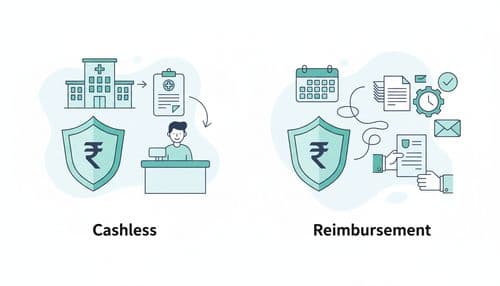
Cashless vs Reimbursement Claim in Health Insurance: A Guide
A detailed guide for Indian families on the difference between cashless and reimbursement health insurance claims, including IRDAI's 2024 rules on timelines, required documents, and the new 'Cashless Everywhere' facility.
Medical Disclaimer
The content provided on Zospital is for general informational and educational purposes only. It is not intended as a substitute for professional medical advice, diagnosis, or treatment. Always seek the advice of your physician or other qualified healthcare provider with any questions you may have regarding a medical condition. Never disregard professional medical advice or delay in seeking it because of something you have read on this website. If you think you may have a medical emergency, call your doctor or emergency services immediately.