Air Ambulance & Medical Evacuation in India: A Guide for NRIs
Medically reviewed by Dr. Nikhil Singh
Last reviewed: 11 Aug 2026
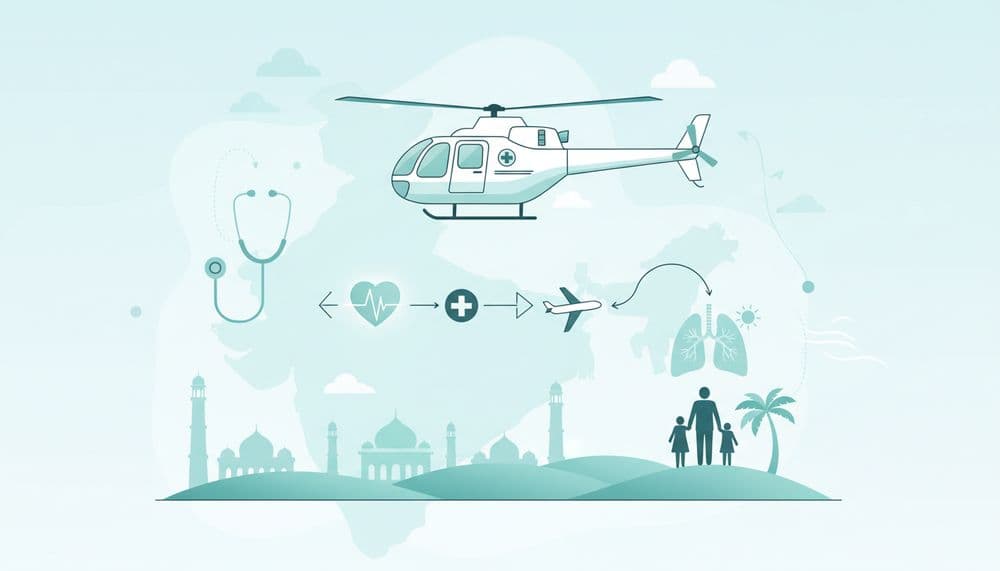
When a medical emergency occurs, time is critical. For Non-Resident Indians (NRIs) managing healthcare for family in India or for international patients seeking treatment, understanding medical transport options is essential. Air ambulances serve as flying Intensive Care Units (ICUs), providing rapid transport for critically ill patients when ground travel is not feasible.
These services are used for emergency evacuations, transfers between hospitals for specialized care, and medical repatriation back to a home country. This guide provides a detailed overview of air ambulance services in India, covering typical costs, insurance coverage, operational standards, and lower-cost alternatives, to help you navigate these complex situations.
Air Ambulance & Medevac Costs at a Glance
Costs are highly variable and depend on aircraft, distance, medical needs, and urgency. Figures are based on available estimates from the specified years.
- Domestic Helicopter (India) — ₹70,000 to ₹10 lakhs per hour (2023-2026 estimates)
- Domestic Fixed-Wing (Delhi to Mumbai) — ₹2.5 lakhs to ₹15 lakhs (2024 estimates)
- International: India to USA — $220,000 - $350,000 (May 2021, during pandemic)
- International: India to UK — Starting from £61,300; can exceed £177,000 (2025 estimates)
Rates shown are as per the Directorate General of Civil Aviation (DGCA), India (2016) and are subject to periodic revision. Always verify the latest approved rates on the official source.
Typical Costs of Air Ambulance Services
The cost of an air ambulance is a significant consideration and varies widely based on several factors, including the type of aircraft, flight distance, the patient's medical condition, and the urgency of the transfer. It's important to obtain a detailed quote from a provider that accounts for all potential charges.
- **Domestic Air Ambulance in India (Helicopters):** Used for shorter distances and reaching remote areas, helicopter costs are typically calculated per hour. Estimates from 2023-2026 place the range between ₹70,000 and ₹10 lakhs per hour.
- **Domestic Air Ambulance in India (Fixed-Wing Aircraft):** For longer city-to-city transfers, fixed-wing aircraft are used. General cost estimates for domestic routes in 2025 range from ₹1.5 lakh to ₹9 lakh, while a 2024 source suggests a wider range of ₹2.5 lakhs to ₹25 lakhs.
- **Specific Domestic Route Costs (2024 Estimates):** Patna to Delhi: ₹4.80 - ₹5.10 lakh. Ranchi to Delhi: ₹5.70 - ₹6.10 lakh. Kolkata to Delhi: ₹7.70 - ₹8.10 lakh. Bangalore to Delhi: ₹9.70 - ₹10.10 lakh. Srinagar to Delhi: ₹4.70 - ₹5.0 lakh. For the common Delhi to Mumbai route, 2024 estimates vary significantly, from ₹2.5 lakhs up to ₹15 lakhs.
- **International Medical Evacuation from India:** Repatriating a patient internationally is substantially more expensive. General estimates from 2025 suggest a range of ₹15 lakh to ₹50 lakh or more.
- **India to the USA:** During the COVID-19 pandemic in May 2021, costs for medical evacuation from India to the US reportedly rose to between $220,000 and $350,000, up from a pre-pandemic range of $15,000 to $150,000.
- **India to the UK:** According to one UK-based provider, prices start from £61,300. Broader estimates for 2025 place long-haul repatriations to the UK between £60,000 and £120,000, with one specific case from India costing £177,929.
When Are Air Ambulance and Medevac Services Used?
Air medical transport is reserved for critical situations where speed and specialized care during transit are paramount. The decision to use an air ambulance is typically made by a physician based on the patient's condition and the limitations of ground transport.
- **Emergency Medical Evacuation (Medevac):** This involves transporting patients from an accident scene or a remote area with limited medical facilities to a hospital that can provide the necessary advanced care. This is common for trauma, stroke, cardiac events, and severe respiratory distress.
- **Inter-Hospital Transfers:** Patients are often moved between hospitals to access a higher level of care. This may be for specialized surgery, organ transplants, or management of post-surgical complications.
- **Medical Repatriation:** This service is crucial for NRIs and foreign nationals who become seriously ill or injured in India and need to be transported back to their home country for ongoing treatment and recovery near their family.
- **High-Altitude Rescue:** In regions like the Himalayas, conditions such as high-altitude cerebral edema (HACE) or pulmonary edema (HAPE) require rapid evacuation to a lower altitude for survival.
Regulatory Oversight and Onboard Medical Standards
Air ambulance operations in India are regulated by the Directorate General of Civil Aviation (DGCA) to ensure safety and quality of care. All commercial providers must hold an Air Operator Certificate (AOC) and adhere to specific requirements for aircraft, equipment, and crew.
The aircraft is equipped to function as a mobile ICU. Standard equipment includes a medical stretcher with restraints, ventilators, defibrillators, multi-parameter patient monitors for ECG and blood pressure, suction units, infusion pumps, and a comprehensive set of emergency medications. For foreign-registered air ambulances, a specific permit is required from the DGCA for each mission, which can take 48 hours or more to process.
The medical team is highly specialized. A typical crew consists of doctors and nurses trained in critical care and aviation medicine. A 2015 draft DGCA circular specified that medical personnel should have at least two years of experience in critical care. Pilots are also specially qualified to handle medical missions and emergency protocols.
Insurance Coverage for Medical Evacuation
Understanding how insurance covers air ambulance costs is critical, as out-of-pocket expenses can be substantial. Coverage differs greatly between standard Indian health policies and international travel insurance.
- **Indian Health Insurance:** Many policies registered with IRDAI offer an 'air ambulance cover', but it comes with significant limitations. Coverage is almost always contingent on being certified as 'medically necessary' by a doctor for a life-threatening emergency. Most importantly, this benefit is usually subject to a sub-limit (e.g., ₹50,000 or a small percentage of the sum insured), which may only be a fraction of the total cost. These policies typically only cover domestic transfers.
- **Travel Insurance and International Assistance:** For NRIs and international travelers, a robust travel insurance policy is the primary source of coverage for medical evacuation. These policies often include emergency medical evacuation benefits that can cover the high cost of repatriation. Experts recommend travelers to India have policies with at least $100,000 in emergency medical coverage and up to $500,000 for medical evacuation. In an emergency, you contact the 24/7 assistance company linked to your policy, which then coordinates the entire process, from medical verification to flight arrangements.
Commercial Airline Stretcher: A More Affordable Alternative
For patients who are medically stable enough to fly on a commercial airline but cannot sit upright for the duration of the flight, a commercial airline stretcher is a viable, lower-cost alternative to a private air ambulance.
This service involves installing a stretcher in a designated section of the economy cabin, typically occupying a block of 6 to 9 seats, which is cordoned off with a privacy curtain. The process requires advance planning and is not suitable for all patients.
The first step is obtaining medical clearance. The patient's treating doctor must complete a Medical Information Form (MEDIF), which is submitted to the airline's medical department for approval. The airline makes the final decision on the patient's fitness to fly. Bookings must be made directly with the airline's call center or office, usually 48-72 hours in advance for domestic flights and 7-10 days for international routes. The patient must be accompanied by a medical escort (doctor or nurse) or a non-medical attendant, as determined by the airline.
Several airlines, including Air India, IndiGo, Lufthansa, Emirates, and Qatar Airways, offer this service. The cost is generally based on the price of the block of seats used (e.g., 6-9 economy fares) plus handling fees. For example, a service provider estimated a domestic commercial stretcher transfer with a medical escort could cost ₹3-4 lakh. International services can range from $15,000 to over $75,000 (2026 estimate), still significantly less than a private medevac flight.
More guides for NRIs and international patients
Related guides from our NRI and international patient hub:
- A Guide to India's Medical Visa and e-Medical Visa for International Patients
- Knee Replacement Cost in India vs. USA, UK & Australia
- Heart Bypass (CABG) Cost in India vs. USA, UK, Australia
- IVF Cost in India for International Patients: A Guide
- Healthcare in India for NRIs and international patients: all guides
Frequently Asked Questions
How much does an air ambulance from Delhi to Mumbai cost?
Based on 2024 estimates, the cost for an air ambulance from Delhi to Mumbai can range widely, from approximately ₹2.5 lakhs to as high as ₹15 lakhs. The final price depends on the aircraft, the patient's medical needs, and the provider.
Does my parents' Indian health insurance cover air ambulance costs?
Many Indian health insurance policies include a benefit for air ambulance services, but it is often very limited. Coverage is typically only for life-threatening emergencies, must be prescribed by a doctor, and is subject to a sub-limit (e.g., ₹50,000) which may not cover the full cost. It's essential to check the specific terms and conditions of their policy.
How do I arrange medical repatriation from India to the UK or USA?
If you have travel insurance with medical evacuation coverage, your first step is to contact the 24/7 assistance company provided by your insurer. They will verify the medical necessity and handle all logistics, including arranging the aircraft, medical team, and communication between hospitals. If you do not have insurance, you will need to contact private air ambulance companies directly to get quotes and arrange the transfer.
What is the difference between a private air ambulance and a commercial airline stretcher?
A private air ambulance is a dedicated, medically-equipped aircraft (a flying ICU) for critically ill patients who need intensive care during transport. A commercial airline stretcher is a service on a regular passenger flight for medically stable patients who cannot sit upright. It is significantly less expensive but requires advance booking and strict medical clearance from the airline.
What medical staff is on board an air ambulance in India?
An air ambulance in India is typically staffed with a specialized medical team, which may include an emergency physician, a critical care nurse, and a paramedic. According to regulatory guidelines, they are trained in aviation medicine and critical care to manage the patient's condition throughout the flight.
How long does it take to arrange an air ambulance in India?
The time required can vary. For domestic transfers, it can sometimes be arranged within a few hours, depending on aircraft and crew availability. For international evacuations, especially those involving a foreign-registered aircraft, the process can take longer as it requires a specific operating permit from the DGCA, which may take 48 hours or more to secure.
Can an air ambulance be used for a non-emergency transfer of a stable patient?
While air ambulances are primarily for emergencies, they can be used for non-emergency transfers if the patient requires medical supervision during flight and cannot travel by other means. However, for a stable patient who simply needs to lie down, a commercial airline stretcher is a much more cost-effective option.
Related
- Healthcare in India for NRIs and international patients: the complete hub
- Treatment costs in India: a complete guide
- Government health schemes in India: a guide
- How to find an Ayushman Bharat (PM-JAY) hospital near you
Medical Disclaimer
The information provided in this article is for general informational and educational purposes only. It is not intended as a substitute for professional medical advice, diagnosis, or treatment. Always seek the advice of your physician or other qualified healthcare provider with any questions you may have regarding a medical condition. Never disregard professional medical advice or delay in seeking it because of something you have read in this article.
Top doctors on Zospital
Verified specialists you can book in minutes.
- Book appointment
Dr N. S . Paliwal
Rehabilitation Specialist
Lucknow
Verified - Book appointment

Dr. Ankit Maheshwari
Gastrologist / Gastroenterologist
Lucknow
Verified•4.7 - Book appointment

Dr. Mrinal Jaiswal
Orthopedic Surgeon
Varanasi
Verified•4.9 - Book appointment

Dr. Salman Khan
ENT
Lucknow
Verified•4.8 - Book appointment

Dr. Richa Gangwar
Gynecologist
Lucknow
Verified•4.9 - Book appointment

Dr. Abhinav Srivastava
Spine Surgeon
Lucknow
Verified•4.9
Have More Questions?
Find quick answers to common questions about our services, appointments, and patient care.
Based on 2024 estimates, the cost for an air ambulance from Delhi to Mumbai can range widely, from approximately ₹2.5 lakhs to as high as ₹15 lakhs. The final price depends on the aircraft, the patient's medical needs, and the provider.
Many Indian health insurance policies include a benefit for air ambulance services, but it is often very limited. Coverage is typically only for life-threatening emergencies, must be prescribed by a doctor, and is subject to a sub-limit (e.g., ₹50,000) which may not cover the full cost. It's essential to check the specific terms and conditions of their policy.
If you have travel insurance with medical evacuation coverage, your first step is to contact the 24/7 assistance company provided by your insurer. They will verify the medical necessity and handle all logistics, including arranging the aircraft, medical team, and communication between hospitals. If you do not have insurance, you will need to contact private air ambulance companies directly to get quotes and arrange the transfer.
A private air ambulance is a dedicated, medically-equipped aircraft (a flying ICU) for critically ill patients who need intensive care during transport. A commercial airline stretcher is a service on a regular passenger flight for medically stable patients who cannot sit upright. It is significantly less expensive but requires advance booking and strict medical clearance from the airline.
An air ambulance in India is typically staffed with a specialized medical team, which may include an emergency physician, a critical care nurse, and a paramedic. According to regulatory guidelines, they are trained in aviation medicine and critical care to manage the patient's condition throughout the flight.
The time required can vary. For domestic transfers, it can sometimes be arranged within a few hours, depending on aircraft and crew availability. For international evacuations, especially those involving a foreign-registered aircraft, the process can take longer as it requires a specific operating permit from the DGCA, which may take 48 hours or more to secure.
While air ambulances are primarily for emergencies, they can be used for non-emergency transfers if the patient requires medical supervision during flight and cannot travel by other means. However, for a stable patient who simply needs to lie down, a commercial airline stretcher is a much more cost-effective option.
Related Articles

Andhra Pradesh Universal Health Policy (Ayushman Bharat - Dr. NTR Vaidya Seva): A Guide
A detailed guide to the Andhra Pradesh Universal Health Policy, which integrates Ayushman Bharat and Dr. NTR Vaidya Seva. Learn about the ₹25 lakh coverage, eligibility criteria for all families, how to enrol, and how the cashless system works in empanelled hospitals.

Anemia: Causes, Symptoms and Treatment
A plain-language guide to anemia, its causes and treatment.

Anemia in Pregnancy: Symptoms & Why It's a Concern
Feeling exhausted during your pregnancy? It might be more than just normal tiredness. Anemia is common during pregnancy, and it's important to know the signs and why it needs attention.
Written by Dr. Nikhil Singh
Last reviewed: 11 August 2026
Medical Disclaimer
The content provided on Zospital is for general informational and educational purposes only. It is not intended as a substitute for professional medical advice, diagnosis, or treatment. Always seek the advice of your physician or other qualified healthcare provider with any questions you may have regarding a medical condition. Never disregard professional medical advice or delay in seeking it because of something you have read on this website. If you think you may have a medical emergency, call your doctor or emergency services immediately.
Are you a doctor or run a clinic or hospital?
Patients across India are searching Zospital right now. Get a free profile with reviews, timings and direct WhatsApp bookings.