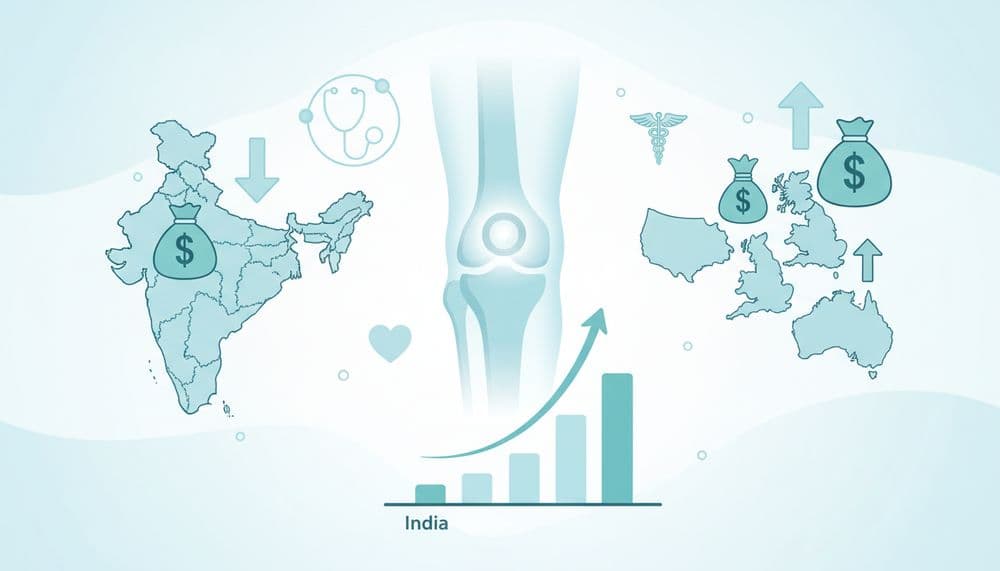
Knee Replacement Cost in India vs. USA, UK & Australia
Medically reviewed by Dr. Nikhil Singh
Last reviewed: 11 Aug 2026
For Non-Resident Indians (NRIs) and international patients considering medical treatment in India, understanding the cost of procedures like total knee replacement (TKR) is a critical first step. India's healthcare landscape offers a wide spectrum of pricing, from government-subsidised rates to comprehensive packages in private facilities.
This article provides a factual comparison of TKR costs in India against those in the United States, the United Kingdom, and Australia. The information is designed to help you make an informed decision when arranging care for yourself or family members in India, based on data from 2023 to 2026.
Total Knee Replacement Cost at a Glance
These figures represent typical cost ranges and may vary based on the hospital, city, implant type, and specific patient needs. Data is based on reports from 2023-2026.
- India (Private Sector Range) — ₹1,50,000 to ₹6,00,000
- USA (Uninsured Average) — $25,000 to $50,000 USD
- UK (Private Package Range) — £12,000 to £16,000 GBP
- Australia (Self-Funded Private) — AUD $20,000 to $35,000
Rates shown are as per the Central Government Health Scheme (CGHS) rate schedule, Ministry of Health & Family Welfare (2024-2026) and are subject to periodic revision. Always verify the latest approved rates on the official source.
TKR Costs in India: Government and Private Options
India provides a diverse range of pricing for total knee replacement, accommodating various budgets through its government and private healthcare systems. The cost can differ significantly based on the type of facility and technology used.
A key benchmark for government-regulated pricing is the Central Government Health Scheme (CGHS). For a total knee replacement, the CGHS package rate is ₹1,26,500 for NABH-accredited hospitals and ₹1,10,000 for non-NABH hospitals. These rates are intended to be comprehensive, but implants may have separate cost caps. For example, a cemented knee implant is capped at ₹60,000 and bone cement at ₹5,000. Robotic knee replacement is also covered under CGHS at empanelled hospitals for eligible beneficiaries.
In the private sector, costs are higher but offer more choice in terms of facilities and scheduling. As of 2024, the general range for a single TKR in a private Indian hospital is from ₹1,50,000 to ₹6,00,000. More specific price brackets reported in 2025 provide a clearer picture:
- **Government Hospitals:** ₹50,000 – ₹1,50,000
- **Mid-Tier Private Hospitals:** ₹2,50,000 – ₹3,50,000
- **Premium/Corporate Hospitals:** ₹3,50,000 – ₹4,50,000
- **Conventional TKR:** ₹2,50,000 – ₹3,00,000
- **Robotic-Assisted TKR:** ₹3,00,000 – ₹3,50,000
Total Knee Replacement Cost in the USA
The cost of a TKR in the United States is considerably higher than in India, the UK, or Australia. For patients without health insurance, the average cost for the procedure can range from $25,000 to $50,000 USD, according to 2024 data. Some estimates place the total cost between $15,000 and $70,000 USD, highlighting the significant price variation across different states and facilities.
One study from 2023 identified an average cost of $29,300 USD for a procedure without complications, while a separate 2024 analysis reported an average of nearly $20,000 USD.
For patients with insurance, including Medicare, TKR is typically covered when deemed medically necessary. However, out-of-pocket expenses can still be substantial. These costs depend on the insurance plan's deductible, copayment, and coinsurance. For instance, a 2023 survey noted an average coinsurance of 20% for a hospital admission, which could leave a patient responsible for several thousand dollars in addition to a copayment that averaged $404.
Total Knee Replacement Cost in the UK
In the United Kingdom, patients can access TKR through the public National Health Service (NHS) or through private healthcare providers.
Through the NHS, the surgery is provided free at the point of use for eligible residents. The primary consideration for patients using the NHS is the potential for significant waiting lists, a factor that has been noted to be more pronounced in recent years.
For those who opt for private treatment to bypass wait times or choose a specific surgeon, the cost is typically bundled into an all-inclusive package. As of 2026, these packages for a single TKR generally range from £12,000 to £16,000 GBP, with some reports citing a wider range of £13,000 to £19,500 GBP. An August 2023 report stated the average private cost was £14,449 GBP. These packages usually cover surgeon and anaesthetist fees, the implant, the hospital stay, and initial post-operative care.
Total Knee Replacement Cost in Australia
Australia's healthcare system also features both public and private pathways for TKR surgery.
In the public system, a medically necessary knee replacement performed in a public hospital is covered by Medicare, making it generally free for the patient. Similar to the UK's NHS, the main drawback is the waiting period. In 2023-24, the median wait time for admission for a TKR in a public hospital was 265 days.
For patients without private health insurance who choose to have the surgery in a private hospital (self-funded), the total cost is estimated to be between AUD $20,000 and $35,000, based on 2026 data. Another 2026 source cites a total cost of approximately AUD $23,000.
Patients with appropriate private health insurance have most of their costs covered by Medicare and their health fund. However, they often face an out-of-pocket expense known as the "gap." In 2023-24, this gap for specialists' fees was typically around AUD $1,000, though it can vary. This is in addition to any excess or co-payment required by the insurance policy itself.
Factors Influencing TKR Costs in India
The wide cost range for knee replacement in India's private sector is influenced by several key factors. When planning for the procedure, it's important to consider the following elements that can affect the final bill:
- **Type of Hospital:** Costs vary significantly between government hospitals, mid-tier private facilities, and large corporate hospital chains.
- **City:** Metropolitan cities like Mumbai, Delhi, and Bangalore may have higher costs compared to Tier-2 or Tier-3 cities.
- **Surgical Technique:** Robotic-assisted TKR generally costs more than conventional surgery due to the advanced technology and equipment involved.
- **Type of Implant:** The brand, material, and design of the knee implant are major cost determinants. Imported implants often cost more than domestically manufactured ones.
- **Surgeon's Experience and Reputation:** Fees for highly experienced surgeons with a strong track record may be higher.
- **Room Type:** The choice of a private room, semi-private room, or general ward during the hospital stay directly impacts the overall cost.
Frequently Asked Questions
What is the official CGHS rate for knee replacement in India?
The Central Government Health Scheme (CGHS) has set package rates for total knee replacement. The rate is ₹1,26,500 for NABH-accredited hospitals and ₹1,10,000 for non-NABH facilities. There are also separate ceiling rates for implants, such as ₹60,000 for a cemented knee implant.
How much does robotic knee replacement cost in India?
In India's private sector, robotic-assisted total knee replacement typically costs between ₹3,00,000 and ₹3,50,000 as of 2025. This is generally higher than conventional TKR, which ranges from ₹2,50,000 to ₹3,00,000. For eligible CGHS beneficiaries, robotic surgery is covered at empanelled hospitals.
Why is knee replacement surgery less expensive in India than in the US?
The cost difference for medical procedures like TKR between India and the US is due to multiple economic factors. These include lower operational and infrastructure costs for hospitals in India, lower professional fees for medical staff, and a different regulatory and insurance landscape. The cost of implants can also be lower, particularly for domestically manufactured products.
What is included in a private TKR package in the UK or Australia?
In the UK, private TKR packages, which cost around £12,000 to £16,000 GBP, typically include surgeon and anaesthetist fees, the implant, the hospital stay, and initial post-operative care. In Australia, for a self-funded patient, the total cost of AUD $20,000 - $35,000 covers similar components, including hospital and specialist fees.
As an NRI, can my parents use government health schemes for knee surgery in India?
Eligibility for government schemes like CGHS depends on specific criteria, primarily related to past or present employment with the Central Government. If your parents are eligible CGHS beneficiaries, they can avail the scheme's benefits, including cashless treatment for TKR at empanelled hospitals.
Are there long waiting lists for knee replacement in India?
The research notes indicate that public healthcare systems in the UK and Australia are associated with significant waiting lists for TKR. While this may also be a factor in Indian government hospitals, the notes do not specify wait times. In India's private sector, patients can typically schedule surgery much more quickly, which is a key reason many opt for private care.
What are the typical out-of-pocket costs for TKR with insurance in the USA?
Even with insurance in the USA, patients often have substantial out-of-pocket costs. These depend on the plan's deductible, copayment (which averaged $404 in a 2023 survey), and coinsurance. With a common 20% coinsurance rate, a patient could be responsible for thousands of dollars of the total procedure cost.
Related
- Healthcare in India for NRIs and international patients: the complete hub
- Treatment costs in India: a complete guide
- Government health schemes in India: a guide
- How to apply for a CGHS card
Medical Disclaimer
The information provided in this article is for general informational and educational purposes only. It is not intended as a substitute for professional medical advice, diagnosis, or treatment. Always seek the advice of your physician or other qualified healthcare provider with any questions you may have regarding a medical condition. Never disregard professional medical advice or delay in seeking it because of something you have read in this article.
Top Orthopaedic surgeon doctors on Zospital
Verified specialists you can book in minutes.
- Book appointment

Dr. Udbhav Agarwal
Orthopedic Surgeon
Prayagraj
Verified•4.1 - Book appointment

Dr. Mrinal Jaiswal
Orthopedic Surgeon
Varanasi
Verified•4.9 - Book appointment

Dr. Shoeb Arif Khan
Orthopedic Surgeon
Lucknow
Verified•4.9 - Book appointment

Dr. Atul Malhotra
Orthopaedic surgeon
Chandigarh
4.9 - Book appointment

Dr. S.K. Gupta
Orthopaedic surgeon
Bhopal
4.8 - Book appointment

Dr. R. P. Singh
Orthopaedic surgeon
Bhopal
4.8
Have More Questions?
Find quick answers to common questions about our services, appointments, and patient care.
The Central Government Health Scheme (CGHS) has set package rates for total knee replacement. The rate is ₹1,26,500 for NABH-accredited hospitals and ₹1,10,000 for non-NABH facilities. There are also separate ceiling rates for implants, such as ₹60,000 for a cemented knee implant.
In India's private sector, robotic-assisted total knee replacement typically costs between ₹3,00,000 and ₹3,50,000 as of 2025. This is generally higher than conventional TKR, which ranges from ₹2,50,000 to ₹3,00,000. For eligible CGHS beneficiaries, robotic surgery is covered at empanelled hospitals.
The cost difference for medical procedures like TKR between India and the US is due to multiple economic factors. These include lower operational and infrastructure costs for hospitals in India, lower professional fees for medical staff, and a different regulatory and insurance landscape. The cost of implants can also be lower, particularly for domestically manufactured products.
In the UK, private TKR packages, which cost around £12,000 to £16,000 GBP, typically include surgeon and anaesthetist fees, the implant, the hospital stay, and initial post-operative care. In Australia, for a self-funded patient, the total cost of AUD $20,000 - $35,000 covers similar components, including hospital and specialist fees.
Eligibility for government schemes like CGHS depends on specific criteria, primarily related to past or present employment with the Central Government. If your parents are eligible CGHS beneficiaries, they can avail the scheme's benefits, including cashless treatment for TKR at empanelled hospitals.
The research notes indicate that public healthcare systems in the UK and Australia are associated with significant waiting lists for TKR. While this may also be a factor in Indian government hospitals, the notes do not specify wait times. In India's private sector, patients can typically schedule surgery much more quickly, which is a key reason many opt for private care.
Even with insurance in the USA, patients often have substantial out-of-pocket costs. These depend on the plan's deductible, copayment (which averaged $404 in a 2023 survey), and coinsurance. With a common 20% coinsurance rate, a patient could be responsible for thousands of dollars of the total procedure cost.
Related Articles

Knee Replacement Kab Zaroori Hai? Kharcha Aur Recovery Ki Jankari
Ghutna badalne (knee replacement) ki salah mili hai? Janiye operation kab sach me zaroori hai, Lucknow me andaazan kharcha, aur recovery.

OPD Appointment at Komal Dev District Hospital, Kanker: A Patient Guide
A practical guide for patients seeking outpatient care at Komal Dev District Hospital, Kanker, covering OPD registration, timings, treatment costs, and applicable government health schemes.

Ladies Doctor in Gorakhpur: Pregnancy Care aur Delivery Ki Jankari
Pregnancy me kab-kab checkup hota hai, kaunse test zaroori hain, aur Gorakhpur me delivery ki planning kaise karein — mahila rog ki aasan guide.
Written by Dr. Nikhil Singh
Last reviewed: 11 August 2026
Medical Disclaimer
The content provided on Zospital is for general informational and educational purposes only. It is not intended as a substitute for professional medical advice, diagnosis, or treatment. Always seek the advice of your physician or other qualified healthcare provider with any questions you may have regarding a medical condition. Never disregard professional medical advice or delay in seeking it because of something you have read on this website. If you think you may have a medical emergency, call your doctor or emergency services immediately.
Are you a doctor or run a clinic or hospital?
Patients across India are searching Zospital right now. Get a free profile with reviews, timings and direct WhatsApp bookings.