Kidney Stone Treatment Costs in India for Patients and NRIs
Medically reviewed by Dr. Nikhil Singh, Anaesthesia, MBBS, MD
Last reviewed: 24 Aug 2026
A Comprehensive Guide to Kidney Stone Treatment Costs in India for Patients and NRIs
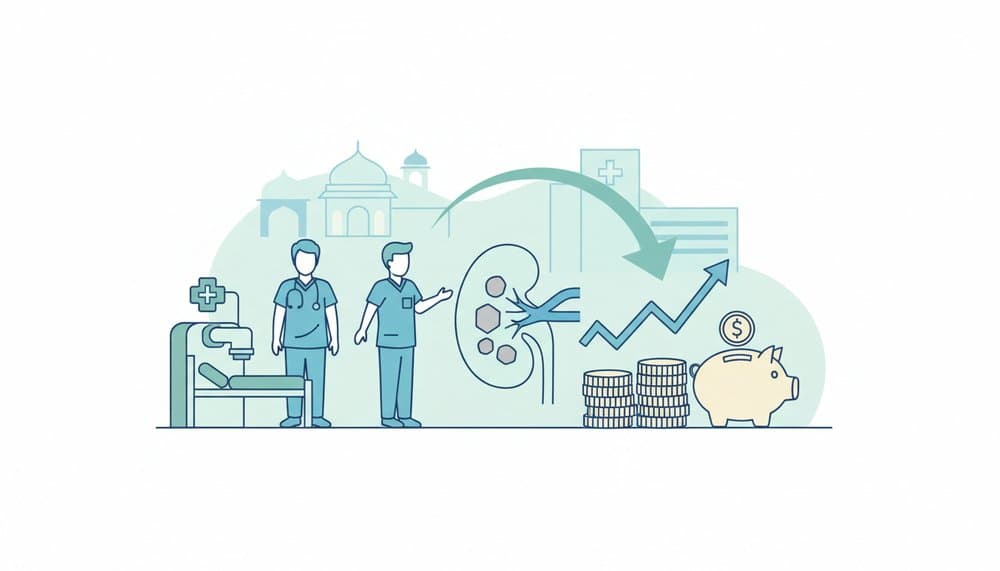
Navigating the landscape of kidney stone treatment can be a daunting experience, marked by discomfort and uncertainty. For patients in India and Non-Resident Indians (NRIs) seeking clarity on their options, understanding the associated costs, procedures, and recovery pathways is crucial. This guide provides a detailed breakdown of kidney stone treatment expenses, from conservative management to advanced surgical interventions, to empower you in making informed healthcare decisions.
Kidney stones, or renal calculi, are hard deposits of minerals and salts that form inside the kidneys. While many small stones may pass without intervention, larger or more complex stones often require medical treatment to prevent severe pain, infection, and potential kidney damage.
Understanding the Financial Aspect: A Breakdown of Treatment Costs
The cost of kidney stone treatment in India is influenced by several factors, including the type of procedure, the size and location of the stone, the choice of hospital, the surgeon's expertise, and the city where the treatment is performed. On average, the overall cost can range from as low as ₹20,000 for non-invasive procedures to upwards of ₹2,50,000 for complex surgeries.
1. Conservative Management: The First Line of Defence
For small stones (typically less than 5 mm) that are likely to pass on their own, doctors often recommend a conservative approach. This method focuses on managing symptoms and aiding the natural passage of the stone.
- What it involves: Increased fluid intake (2-3 litres of water per day), pain relief medications (like NSAIDs), and sometimes alpha-blockers to relax the muscles in the ureter, making it easier for the stone to pass.
- Associated Costs: This is the most economical approach. Costs are generally limited to:
- Urologist Consultation Fees: ₹600 - ₹1,500 per visit.
- Medications: ₹500 - ₹2,000 for pain relievers and alpha-blockers.
- Diagnostic Tests: An initial ultrasound (USG KUB) can cost between ₹1,500 - ₹2,500, and a follow-up scan may be required. A more detailed CT scan (NCCT KUB), considered the gold standard, can range from ₹3,000 to ₹6,000.
Estimated Total Cost for Conservative Management: ₹5,000 - ₹10,000
2. Non-Invasive and Minimally Invasive Procedures
When stones are too large to pass, cause significant pain, or block urine flow, active treatment is necessary. Modern urology offers several effective procedures with varying costs and recovery times.
Cost Comparison of Kidney Stone Procedures in India (INR)
Procedure — Description — National Average Cost Range (₹) — Delhi Cost Range (₹) — Mumbai Cost Range (₹) — Bangalore Cost Range (₹) — Chennai Cost Range (₹) — Hyderabad Cost Range (₹)
ESWL (Lithotripsy) — Uses external shock waves to break stones into smaller, passable fragments. Non-invasive. — 30,000 - 60,000 — 30,000 - 60,000 — 30,000 - 60,000 — 30,000 - 60,000 — 10,000 - 80,750 — 20,000 - 50,000
URS (Ureteroscopy) — A thin scope is passed through the urethra to remove or break stones in the ureter or kidney, often with a laser. — 40,000 - 1,00,000 — 59,900 - 1,18,000 — 40,000 - 80,000 — 40,000 - 55,000 — 40,000 - 96,000 — 35,000 - 60,000
RIRS (Retrograde Intrarenal Surgery) — A flexible ureteroscope is used to reach and break larger or complex stones within the kidney itself. — 80,000 - 2,00,000 — 1,46,410 - 2,01,000 — 90,000 - 1,80,000 — 70,000 - 1,05,000 — 70,000 - 1,05,000 — 70,000 - 1,05,000
PCNL (Percutaneous Nephrolithotomy) — A small incision is made in the back to directly access and remove very large or staghorn stones from the kidney. — 60,000 - 2,00,000 — 70,000 - 90,000 — 70,000 - 1,00,000 — 60,000 - 85,000 — 47,500 - 1,71,000 — 60,000 - 1,50,000
Note: These prices are estimates and can vary. They often include surgeon fees, anesthesia, OT charges, and a standard room stay but may not cover pre-operative diagnostics, post-operative medications, or the cost of a DJ stent if required.
The Decision-Making Framework: Choosing the Right Treatment
The choice of treatment is a clinical decision made by your urologist based on several factors. As a patient, understanding these factors can help you have a more productive discussion with your doctor.
Factor — Conservative Management — ESWL — URS / RIRS — PCNL
Stone Size — < 5 mm — < 20 mm (in kidney), < 10 mm (in ureter) — < 20 mm — > 20 mm, including large and complex staghorn stones
Stone Location — Anywhere, as long as it's likely to pass — Kidney and upper ureter — Mid to lower ureter (URS), kidney and upper ureter (RIRS) — Large stones located within the kidney
Stone Hardness — Not a primary factor — Less effective on very hard stones (e.g., calcium oxalate monohydrate) — Effective on most stone types with modern lasers (Holmium, Thulium) — The most effective method for removing very hard and large stones
Patient Factors — Tolerable pain, no signs of infection or blockage — Good overall health, not pregnant, no bleeding disorders — Suitable for most patients, including those on blood thinners (with care) — Reserved for cases where other methods are unsuitable or have failed
Key Advantage — Avoids a procedure — Non-invasive, quick recovery — High success rate, minimally invasive — Highest stone-free rate for large stones in a single session
Selecting the Right Hospital and Surgeon: A Checklist for Quality Care
Choosing where and by whom you get treated is as important as the treatment itself. Look beyond just the cost and consider these crucial criteria:
- Accreditation: Opt for hospitals with national (NABH) or international (JCI) accreditation. This ensures the facility adheres to stringent quality and safety standards in patient care.
- Urologist's Credentials and Experience:
- Qualifications: Look for a surgeon with an MCh or DNB in Urology.
- Specialization: A urologist with a focus on endourology (minimally invasive surgery) is often preferable for stone disease.
- Experience: Ask about the surgeon's experience. How many RIRS or PCNL procedures do they perform annually? High volume often correlates with better outcomes.
- Technology and Infrastructure:
- Advanced Lasers: Hospitals equipped with modern lasers like the Thulium Fiber Laser (TFL) may offer more efficient stone fragmentation and dusting compared to the traditional Holmium:YAG laser, potentially reducing procedure time.
- Scope Technology: The availability of high-quality flexible ureteroscopes is essential for performing RIRS effectively.
- Diagnostics: Ensure the hospital has advanced imaging like high-resolution CT scanners for accurate diagnosis and planning.
- Transparency and Patient Care:
- Clear Communication: A good doctor will explain all your options, the rationale for their recommendation, and the associated risks without pressuring you.
- Patient Reviews: Look for testimonials and patient stories to gauge the quality of care and patient satisfaction.
- Insurance and Costs: Inquire about cashless facilities and get a detailed cost estimate upfront to avoid surprises.
Recovery Timelines: What to Expect After Your Procedure
Recovery varies significantly depending on the invasiveness of the procedure. Proper post-operative care is vital to reduce complications, ensure complete stone clearance, and prevent future occurrences.
| Procedure | Hospital Stay | Return to Light Activities | Full Recovery / Return to Strenuous Activity | Key Recovery Notes
Written by
Top Anesthesiologist doctors in Lucknow on Zospital
Verified specialists you can book in minutes.
- Book appointment

Dr. Sanni Deyol Gautam
Anesthesiologist
Lucknow
4.8 - Book appointment

Dr Karanvir Singh Sidhu
Anesthesiologist
Lucknow
4.8 - Book appointment

Dr Harpreet Kaur
Anesthesiologist
Lucknow
4.8 - Book appointment

Dr. Akshat Trivedi
Anesthesiologist
Lucknow
4.5 - Book appointment
Aveline Pascual Jerome, MD
Anesthesiologist
Ajmer
5 - Book appointment
Dr. Vivek Kumar Sharma - Laser & Advanced Laparoscopy Surgeon In Ajmer
Anesthesiologist
Ajmer
4.7

“Your Health, Our Priority. Your Voice, Our Guide”
Dr. Nikhil Singh
Anaesthesia, MBBS, MD
Private hospitals in Lucknow on Zospital
Prefer a private option? These hospitals in Lucknow list their doctors and take bookings.
- Paarth Eye Hospital & Retina Centre
- Urmila Devi Memorial Hospital- Child Specialist Hospital in Lucknow | Pediatrician hospital
- SPARSH CHILDREN'S HOSPITAL & VACCINATION CENTER | Child Hospital in Raebareli Road Lucknow | Dr. Akhilesh Pandey |
Related Articles

Kidney Stones: Causes, Symptoms and Prevention
A plain-language guide to kidney stones, their symptoms, treatment and prevention.

Kidney Transplant Cost in India: A Typical Price Guide
A practical guide to typical kidney transplant costs in private hospitals in India and the ongoing medication cost.
Kidney Transplant Cost in India vs. USA/UK: A Guide for NRIs
Comparing kidney transplant costs in India (from $6,000) vs the US ($442k) & UK ($82k+). A guide for NRIs on regulations, donor laws, and post-op expenses.

Written by Dr. Nikhil Singh
Anaesthesia, MBBS, MD
Last reviewed: 24 August 2026
Medical Disclaimer
The content provided on Zospital is for general informational and educational purposes only. It is not intended as a substitute for professional medical advice, diagnosis, or treatment. Always seek the advice of your physician or other qualified healthcare provider with any questions you may have regarding a medical condition. Never disregard professional medical advice or delay in seeking it because of something you have read on this website. If you think you may have a medical emergency, call your doctor or emergency services immediately.
Are you a doctor or run a clinic or hospital?
Patients across India are searching Zospital right now. Get a free profile with reviews, timings and direct WhatsApp bookings.