Cystoscopy & Ureteroscopy in India: Costs & Recovery
Medically reviewed by Dr. Nikhil Singh, Anaesthesia, MBBS, MD
Last reviewed: 24 Aug 2026
A Comprehensive Guide to Cystoscopy and Ureteroscopy in India: Costs, Choices, and Recovery
For patients in India and Non-Resident Indians (NRIs) navigating the landscape of urological health, understanding the procedures of cystoscopy and ureteroscopy is crucial. These minimally invasive techniques are fundamental to diagnosing and treating a range of conditions affecting the urinary tract. This guide provides a detailed breakdown of what these procedures entail, their associated costs in India, how to select the right hospital and specialist, and what to expect during recovery.
Understanding the Procedures: Cystoscopy vs. Ureteroscopy
At first glance, cystoscopy and ureteroscopy might seem similar as both involve inserting a thin, lighted scope into the urinary tract. However, their purpose and reach are distinct.
Cystoscopy is a procedure focused on the lower urinary tract. A urologist uses a cystoscope—a thin tube with a camera and light—to examine the lining of the urethra and bladder. It is instrumental in investigating symptoms like blood in the urine (hematuria), frequent urinary tract infections (UTIs), painful urination, and urinary incontinence. Cystoscopy can be:
- Diagnostic: Simply to inspect the bladder and urethra for abnormalities like tumours, stones, inflammation, or strictures (narrowing).
- Therapeutic: To perform minor treatments, such as removing small bladder stones, taking a tissue sample (biopsy), or injecting medication into the bladder wall.
Cystoscopes come in two forms: flexible and rigid. Flexible cystoscopies are often used for diagnosis and can be done with local anaesthesia, offering greater comfort. Rigid cystoscopes are slightly wider and are typically used when therapeutic intervention is needed, as they allow for the passage of surgical instruments.
Ureteroscopy, on the other hand, extends beyond the bladder to examine the upper urinary tract. The ureteroscope is longer and thinner than a cystoscope, allowing the urologist to navigate through the bladder and into the ureters—the tubes connecting the kidneys to the bladder—and even into the kidney itself. Its primary uses are:
- Diagnostic: To find the cause of a blockage in the ureter or to investigate abnormalities seen on imaging scans.
- Therapeutic: It is a mainstay for treating kidney and ureteral stones. Using a laser fiber passed through the scope, stones can be fragmented (a procedure known as laser lithotripsy) and then removed with a small basket. It is also used to take biopsies of suspicious tissues in the ureter or kidney lining or to treat strictures. A common advanced form of this procedure is Retrograde Intrarenal Surgery (RIRS), which uses a flexible ureteroscope to treat stones within the kidney.
Decoding the Costs: A Detailed Financial Overview
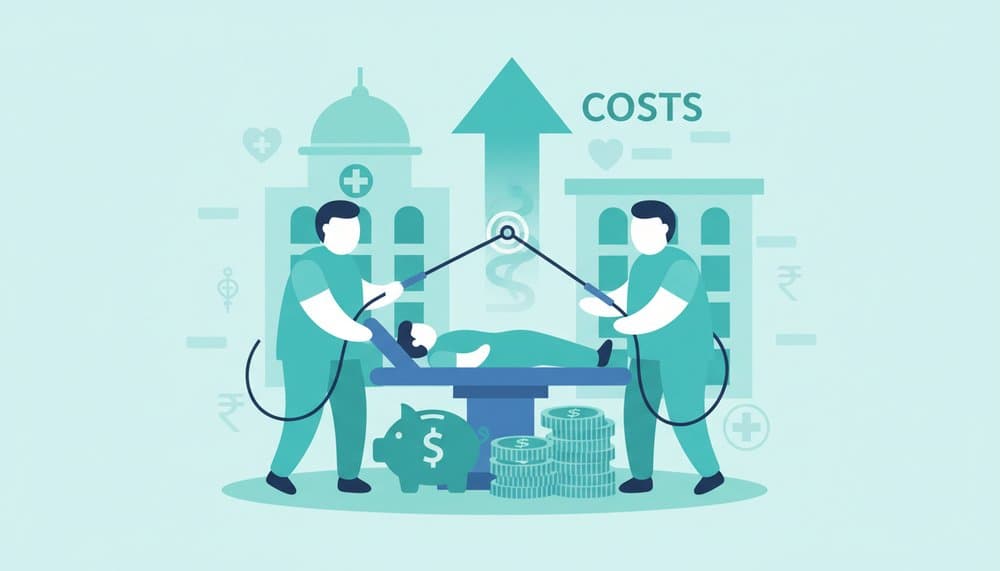
The cost of cystoscopy and ureteroscopy in India is significantly lower than in Western countries, making it a viable option for many, including NRIs. However, prices can vary widely based on several factors.
Factors Influencing Cost:
- Procedure Type: A simple diagnostic scope is the most affordable. Costs increase with therapeutic interventions like biopsy, stone removal, or laser use.
- Hospital Type: Government hospitals are the most budget-friendly, but may have longer waiting times. Private hospitals, from smaller clinics to large multi-speciality centres, offer a wider range of costs and services.
- City/Location: Metropolitan cities like Mumbai, Delhi, and Bangalore tend to have higher costs compared to Tier-2 and Tier-3 cities, reflecting higher operational expenses.
- Technology Used: The use of advanced technology, such as flexible scopes, laser systems (Holmium or Thulium Fiber), or enhanced imaging like Blue Light Cystoscopy, will increase the price.
- Surgeon’s Experience: Highly experienced urologists may charge higher consultation and procedure fees.
- Anesthesia: Procedures under local anaesthesia are less expensive than those requiring sedation or general anaesthesia.
- Additional Expenses: The final bill will also include pre-procedure consultations and diagnostic tests (like urine analysis, ultrasound, or CT scans), post-procedure medications, and the potential cost of a ureteral stent.
Estimated Cost Tables
The following tables provide an estimated range of costs for these procedures in India. These are indicative and can vary. It is always advisable to get a detailed, itemised quote from the hospital beforehand.
Table 1: Estimated Cost of Cystoscopy in India (in INR)
Procedure Type — Government Hospital — Private Hospital (Tier-2 City) — Private Hospital (Tier-1 City)
Diagnostic Cystoscopy (Flexible) — ₹5,000 - ₹15,000 — ₹10,000 - ₹25,000 — ₹15,000 - ₹40,000
Cystoscopy with Biopsy — ₹10,000 - ₹20,000 — ₹20,000 - ₹45,000 — ₹40,000 - ₹66,000+
Cystoscopy with Bladder Stone Removal — ₹15,000 - ₹30,000 — ₹30,000 - ₹60,000 — ₹50,000 - ₹80,000+
Sources: Based on data from multiple healthcare providers and aggregators.
Table 2: Estimated Cost of Ureteroscopy (URS) in India (in INR)
Procedure Type — Government Hospital — Private Hospital (Tier-2 City) — Private Hospital (Tier-1 City)
Diagnostic Ureteroscopy — ₹20,000 - ₹40,000 — ₹40,000 - ₹70,000 — ₹60,000 - ₹90,000
URS with Stone Removal (Rigid/Semi-Rigid) — ₹30,000 - ₹60,000 — ₹50,000 - ₹85,000 — ₹70,000 - ₹1,20,000
Flexible URS (RIRS) with Laser Lithotripsy — ₹60,000 - ₹90,000 — ₹90,000 - ₹1,30,000 — ₹1,25,000 - ₹2,50,000+
Sources: Based on data from various hospitals and healthcare platforms.
The Decision-Making Framework: Choosing the Right Path
The choice between these procedures—or whether to have one at all—is a clinical decision made in consultation with your urologist. Here’s a framework to guide your discussion.
When is each procedure recommended?
- Cystoscopy is the first line of investigation for symptoms pointing to a problem in the bladder or urethra. This includes unexplained blood in urine, chronic UTIs, or difficulty urinating.
- Ureteroscopy is chosen when the problem is suspected to be higher up, in the ureters or kidneys. It is the go-to procedure for removing stones that are too large to pass on their own, are causing significant pain or blockage, or have not been broken up by non-invasive methods like shock wave lithotripsy (ESWL).
Key Questions to Ask Your Urologist: A well-informed patient is an empowered one. Before consenting to any procedure, consider asking your doctor the following questions:
- About the Procedure:
- Why is this specific procedure necessary for me? Are there any alternatives, such as medication or observation?
- What type of scope will be used (flexible or rigid)?
- Will this be a diagnostic or a therapeutic procedure? Is there a possibility you will need to perform a biopsy or remove a stone during the procedure?
- What type of anaesthesia will be used?
- What is your experience with this procedure? How many do you perform annually?
- About Risks and Outcomes:
- What is the success rate for this procedure for my condition?
- What are the potential risks and complications (e.g., infection, bleeding, discomfort)?
- Will a ureteral stent be placed? If so, for how long, and what should I expect while it's in?
- About Costs and Logistics:
- Can you provide a detailed, itemised estimate of the total cost, including pre-operative tests, surgeon’s fee, anaesthesia, and post-operative care?
- Is this procedure covered by my insurance policy?
- How long will I need to be at the hospital?
Choosing the Right Hospital: Beyond the Name
Selecting the right facility is as important as choosing the right doctor. Here are key criteria to consider:
- Accreditation: Look for hospitals accredited by the National Accreditation Board for Hospitals & Healthcare Providers (NABH) or Joint Commission International (JCI). NABH is India's leading standard, ensuring adherence to rigorous quality and patient safety protocols. JCI is a global gold standard, often sought by hospitals catering to international patients. These accreditations signify a commitment to high standards in patient care, infection control, and ethical practices.
- Urology Department and Specialisation: A hospital with a dedicated urology department, or a "Centre of Excellence," is preferable. Check if they have specialists for your specific condition (e.g., endourology for stones, uro-oncology for cancer).
- Technological Infrastructure: The availability of modern technology can significantly impact outcomes. For ureteroscopy, inquire about the type of lasers available. Thulium Fiber Laser (TFL) is a newer technology that studies suggest may offer shorter operating times and higher efficiency compared to the standard Holmium:YAG laser. For bladder cancer diagnosis, some advanced centres in India offer Blue Light Cystoscopy (BLC), which can improve the detection of certain tumours compared to standard white light.
- Surgeon's Expertise: Research the credentials and experience of the urologists. A surgeon who performs a high volume of a specific procedure is generally preferred.
- Patient Reviews and Transparency: Look for patient testimonials and check if the hospital is transparent with its pricing and outcomes.
Recovery Timelines: What to Expect After the Procedure
Recovery is generally quick for these minimally invasive procedures, but experiences can vary.
After a Cystoscopy:
- First 24-48 Hours: It is common to experience a burning sensation while urinating and a frequent urge to go. Your urine may appear pink-tinged due to slight bleeding. Drinking plenty of water helps flush t
Written by
Top Anesthesiologist doctors in Lucknow on Zospital
Verified specialists you can book in minutes.
- Book appointment

Dr. Sanni Deyol Gautam
Anesthesiologist
Lucknow
4.8 - Book appointment

Dr Karanvir Singh Sidhu
Anesthesiologist
Lucknow
4.8 - Book appointment

Dr Harpreet Kaur
Anesthesiologist
Lucknow
4.8 - Book appointment

Dr. Akshat Trivedi
Anesthesiologist
Lucknow
4.5 - Book appointment
Aveline Pascual Jerome, MD
Anesthesiologist
Ajmer
5 - Book appointment
Dr. Vivek Kumar Sharma - Laser & Advanced Laparoscopy Surgeon In Ajmer
Anesthesiologist
Ajmer
4.7

“Your Health, Our Priority. Your Voice, Our Guide”
Dr. Nikhil Singh
Anaesthesia, MBBS, MD
Private hospitals in Lucknow on Zospital
Prefer a private option? These hospitals in Lucknow list their doctors and take bookings.
- Paarth Eye Hospital & Retina Centre
- Urmila Devi Memorial Hospital- Child Specialist Hospital in Lucknow | Pediatrician hospital
- SPARSH CHILDREN'S HOSPITAL & VACCINATION CENTER | Child Hospital in Raebareli Road Lucknow | Dr. Akhilesh Pandey |
Related Articles
Darbhanga Medical College and Hospital (DMCH): Appointment, OPD, and Costs
A guide to getting treatment at Darbhanga Medical College and Hospital (DMCH), covering OPD appointments, costs, and available government schemes.

OPD Appointment Guide: Deen Dayal Upadhyay Hospital, New Delhi
A factual patient guide explaining how to access outpatient services at Deen Dayal Upadhyay Hospital (DDU Hospital), a Delhi Government hospital in Hari Nagar, West Delhi.

Ayushman Bharat PM-JAY in Delhi: A Comprehensive Guide
A detailed guide to the Ayushman Bharat Pradhan Mantri Jan Arogya Yojana (PM-JAY) in Delhi, including the state government's top-up, eligibility criteria, enrolment process, and benefits for residents.
Written by Dr. Nikhil Singh
Anaesthesia, MBBS, MD
Last reviewed: 24 August 2026
Medical Disclaimer
The content provided on Zospital is for general informational and educational purposes only. It is not intended as a substitute for professional medical advice, diagnosis, or treatment. Always seek the advice of your physician or other qualified healthcare provider with any questions you may have regarding a medical condition. Never disregard professional medical advice or delay in seeking it because of something you have read on this website. If you think you may have a medical emergency, call your doctor or emergency services immediately.
Are you a doctor or run a clinic or hospital?
Patients across India are searching Zospital right now. Get a free profile with reviews, timings and direct WhatsApp bookings.