Emergency Numbers for Indians Abroad: Protocols & Costs
Medically reviewed by Dr. Nikhil Singh, Anaesthesia, MBBS, MD
Last reviewed: 24 Aug 2026
A Comprehensive Guide to Medical Emergencies Abroad for Indian Nationals and NRIs
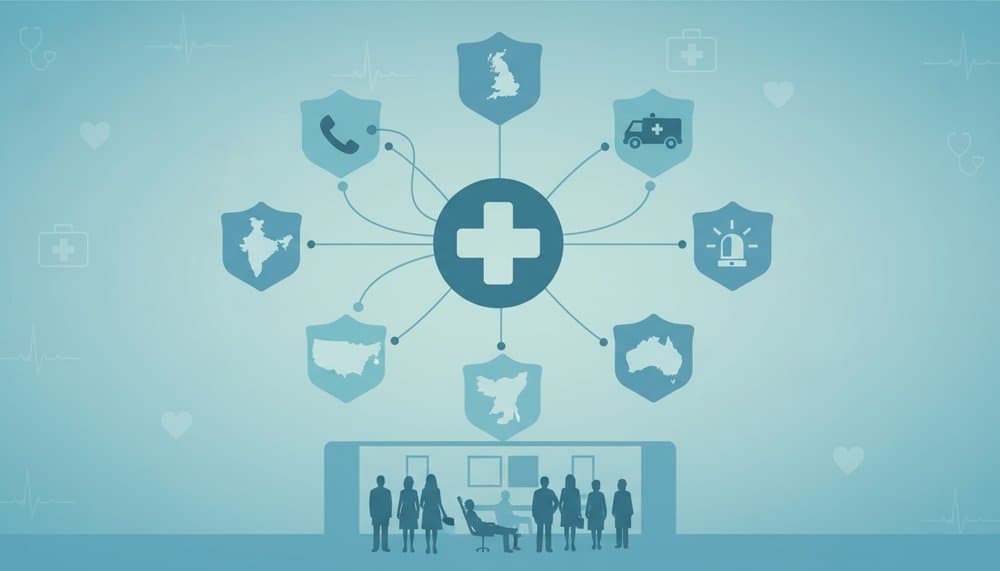
Navigating a medical emergency is a stressful experience, and when it happens in a foreign country, the complexity can feel overwhelming. This guide provides detailed, practical information for Indian citizens and Non-Resident Indians (NRIs) on emergency protocols, costs, and hospital navigation in the United States, Canada, the United Kingdom, Australia, and key countries in the Middle East.
*
Disclaimer
This guide is for informational purposes only and does not constitute medical advice. It is based on information available as of August 2026. Healthcare systems, costs, and regulations can change. Always consult with local authorities and your insurance provider for the most current information. In a life-threatening emergency, your first action should always be to contact local emergency services.
United States of America
The U.S. healthcare system is known for its advanced care and its exceptionally high costs, especially for those without adequate insurance. It is a predominantly private system, and understanding how to navigate it is crucial.
At-a-Glance: USA Emergency Sheet
Service — Contact
All Emergencies (Police, Fire, Ambulance) — 911
Poison Control — 1-800-222-1222
Key Advice — Travel insurance is absolutely essential. Even a minor emergency room visit can cost thousands of dollars. Specify your location as precisely as possible when calling 911.
Calling for Help: The 911 Protocol
When you dial 911, the call is free from any phone. An operator, also known as a dispatcher, will answer with a phrase like, "911, what is the address of your emergency?".
What to Expect:
- State Your Location: This is the most critical piece of information. Provide the full address, including city, street name, and apartment number. If you're on a highway, give the road name, direction, and nearest mile marker or exit. Many 911 systems are "Enhanced 911" (E9-1-1), which automatically provides your phone number and location, but you will always be asked to verify it.
- State the Nature of the Emergency: Clearly and calmly say what is wrong, for example, "Someone is having chest pain," "There's been a car accident," or "Someone is unconscious."
- Answer All Questions: The dispatcher is trained to gather essential information to determine the right level of response. While they are talking to you, help is already being dispatched. Do not hang up until the operator tells you to. They may provide pre-arrival instructions, such as how to perform CPR.
The Cost of Care: What to Expect Financially
Healthcare in the U.S. is a business. Hospitals are required by law (EMTALA) to provide stabilizing emergency care to anyone, regardless of their ability to pay. However, this does not mean the care is free. You will be billed for the full amount afterward.
Estimated Costs for Uninsured Patients:
Service — Estimated Cost (USD)
Ambulance Ride — $500 - $2,000+
Urgent Care Visit (non-life-threatening) — $150 - $300 (base fee)
Emergency Room (ER) Visit — $2,000 - $3,000+ (average, can be much higher)
MRI Scan — $900 - $1,500+
Treatment for a Broken Bone — $2,500 - $12,000+
Appendectomy (Emergency Surgery) — $20,000+
Hospital Stay (per day) — $2,000 - $5,000+
These are estimates and can vary significantly by state, hospital, and the complexity of care.
Decision Framework: ER vs. Urgent Care
Choosing the right facility can save you thousands of dollars.
- Go to the Emergency Room (ER) for: Life-threatening conditions such as chest pain, difficulty breathing, signs of a stroke, severe bleeding, major broken bones, or loss of consciousness.
- Go to an Urgent Care Center for: Non-life-threatening issues like minor cuts, sprains, colds, flu symptoms, rashes, or minor infections. Urgent care is significantly faster and more affordable than an ER for these conditions.
Hospital Selection Criteria
- If You Have Travel Insurance: Your insurance plan is the key. Most U.S. plans use a PPO (Preferred Provider Organization) network. Staying "in-network" means the insurer has pre-negotiated rates with those hospitals, drastically reducing your out-of-pocket costs. Before your trip, identify in-network hospitals and urgent care centers near where you'll be staying. Your insurance provider's 24/7 assistance line can help you find one in an emergency.
- If You Are Uninsured: In a true emergency, go to the nearest hospital. The priority is immediate care. All hospitals will stabilize you. However, you will be responsible for the full bill. You can later contact the hospital's financial assistance department to inquire about "charity care" or negotiate the bill, but this is not guaranteed.
Canada
Canada has a publicly funded healthcare system, but this coverage is for Canadian citizens and permanent residents. As a visitor, you are not covered and must pay for medical services out-of-pocket.
At-a-Glance: Canada Emergency Sheet
Service — Contact
All Emergencies (Police, Fire, Ambulance) — 911
Telehealth Nurse Line (Health advice) — 811 (in most provinces)
Key Advice — Travel insurance is critical. Canada does not pay for hospital or medical services for visitors. Without it, you face significant personal expense.
Calling for Help: The 911 Protocol
The process is identical to the U.S. Stay calm, state your location, describe the emergency, and answer all questions. In a life-threatening situation, do not hesitate to call 911.
The Cost of Care: What to Expect Financially
While Canadians enjoy "free" healthcare, the system has set rates for non-residents that are very high. You will be expected to pay for services, either upfront or via a bill sent to you.
Estimated Costs for Non-Residents (CAD):
Service — Estimated Cost (CAD)
Ambulance — $500+
Emergency Room Visit — $1,000 - $2,000+
X-Ray — $75 - $360
CT Scan / MRI — $900 - $2,000
Hip Fracture — $13,000 - $20,000
Heart Attack Treatment — $26,000+ (can exceed $100,000 with surgery)
Hospital Stay (Ward, per day) — $2,500 - $7,000
Hospital Stay (ICU, per day) — $10,000+
Source:
Hospital Selection and Process
- The Triage System: In a Canadian ER, you don't get seen in order of arrival. A triage nurse will assess your condition and prioritize patients based on medical urgency. This means if your condition is not severe, you may face long wait times.
- Choosing a Hospital: In an emergency, you will be taken to the nearest hospital. There isn't a meaningful distinction between "public" and "private" hospitals for emergency care in the way there is in other countries. All major hospitals have ERs.
- Payment: Upon arrival, the registration desk will ask for your personal information and any insurance details. If you have appropriate travel insurance, the hospital may be able to bill the insurer directly. If not, you are personally responsible for the costs. For less severe issues, consider a walk-in clinic, which is a cheaper and faster alternative to the ER.
United Kingdom
The UK's National Health Service (NHS) is a comprehensive public healthcare system. Its approach to emergency care for visitors is a crucial distinction from other countries.
At-a-Glance: UK Emergency Sheet
Service — Contact
All Emergencies (Police, Fire, Ambulance) — 999 or 112
Non-Emergency Medical Advice — 111
Key Advice — Emergency treatment in an Accident & Emergency (A&E) department is free for everyone, regardless of nationality or residency status. However, if you are admitted to the hospital as an inpatient, charges will apply.
Calling for Help: The 999 Protocol
When you dial 999 or 112, an operator will ask, "Emergency. Which service?" You should state whether you need an Ambulance, Police, or Fire service. You will then be transferred to the appropriate dispatcher who will ask for your location and details of the emergency.
The Cost of Care: A Two-Tier System for Visitors
- Free Emergency Care: Any treatment received in an A&E department is free of charge. This includes the initial assessment, tests, and immediate treatment required to stabilize your condition. An ambulance ride to the hospital is also free if deemed medically necessary.
- Charged Inpatient and Follow-up Care: If the A&E doctor decides you need to be admitted to the hospital (e.g., for surgery or overnight observation), you become an "overseas visitor" patient and will be charged for this care. These charges are set at 150% of the standard NHS rate.
Estimated Costs for Overseas Visitors (if admitted):
Service — Estimated Cost (GBP)
A&E Visit — £0 (Free)
GP (Doctor) Consultation — £40 - £60
X-Ray — £100 - £150
Hospital Stay (per night) — £400 - £900+
Prescription Medication — £9.65 per item (approx.)
Source:
Hospital Selection Criteria
In an emergency, you do not "choose" a hospital. You go to the nearest NHS hospital with an A&E department. The system is not designed for shopping around. Private hospitals in the UK generally do not have emergency departments equipped to handle major trauma or critical emergencies. The NHS is the primary provider of emergency care.
Australia
Australia has a high-quality public healthcare system called Medicare, but it generally does not cover tourists or temporary visitors. Like the US and Canada, healthcar
Top Anesthesiologist doctors in Lucknow on Zospital
Verified specialists you can book in minutes.
- Book appointment

Dr. Sanni Deyol Gautam
Anesthesiologist
Lucknow
4.8 - Book appointment

Dr Karanvir Singh Sidhu
Anesthesiologist
Lucknow
4.8 - Book appointment

Dr Harpreet Kaur
Anesthesiologist
Lucknow
4.8 - Book appointment

Dr. Akshat Trivedi
Anesthesiologist
Lucknow
4.5 - Book appointment
Aveline Pascual Jerome, MD
Anesthesiologist
Ajmer
5 - Book appointment
Dr. Vivek Kumar Sharma - Laser & Advanced Laparoscopy Surgeon In Ajmer
Anesthesiologist
Ajmer
4.7

“Your Health, Our Priority. Your Voice, Our Guide”
Dr. Nikhil Singh
Anaesthesia, MBBS, MD
Private hospitals in Lucknow on Zospital
Prefer a private option? These hospitals in Lucknow list their doctors and take bookings.
- Paarth Eye Hospital & Retina Centre
- Urmila Devi Memorial Hospital- Child Specialist Hospital in Lucknow | Pediatrician hospital
- SPARSH CHILDREN'S HOSPITAL & VACCINATION CENTER | Child Hospital in Raebareli Road Lucknow | Dr. Akhilesh Pandey |
Related Articles

Emergency Room Visit Costs & Process in India
Learn about the logistics and costs of an emergency room visit in India. This guide covers what to expect from registration to discharge, including timelines

Emergency Telemedicine for NRIs in India: 24/7 Access for Family
Non-Resident Indians can use emergency telemedicine in India for 24/7 access to medical advice and urgent consultations for family.

Emergency & Urgent Care: Complete Guide
For Indians and NRIs abroad, this guide explains how to manage a medical emergency. Learn to navigate foreign healthcare systems and financial issues.

Written by Dr. Nikhil Singh
Anaesthesia, MBBS, MD
Last reviewed: 24 August 2026
Medical Disclaimer
The content provided on Zospital is for general informational and educational purposes only. It is not intended as a substitute for professional medical advice, diagnosis, or treatment. Always seek the advice of your physician or other qualified healthcare provider with any questions you may have regarding a medical condition. Never disregard professional medical advice or delay in seeking it because of something you have read on this website. If you think you may have a medical emergency, call your doctor or emergency services immediately.
Are you a doctor or run a clinic or hospital?
Patients across India are searching Zospital right now. Get a free profile with reviews, timings and direct WhatsApp bookings.