Emergency Room Visit Costs & Process in India
Medically reviewed by Dr. Nikhil Singh, Anaesthesia, MBBS, MD
Last reviewed: 24 Aug 2026
Navigating the Costs and Complexities of an Emergency Room Visit in India: A Detailed Guide for Patients
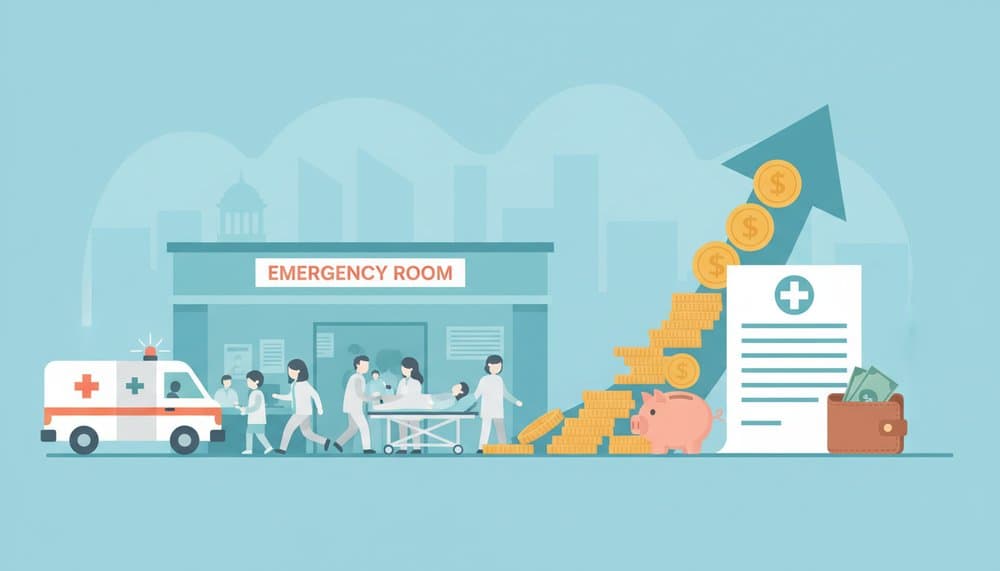
A medical emergency is a stressful and often frightening experience. Beyond the immediate health concerns, navigating the logistics and costs of an emergency room (ER) visit in India can be overwhelming, for both residents and Non-Resident Indians (NRIs) managing the care of their loved ones. This guide provides a comprehensive overview of what to expect during an ER visit, from initial registration to post-discharge care, with a focus on costs, timelines, and crucial decision-making.
The Moment of Crisis: Choosing the Right Hospital
In an emergency, every second counts. The choice of hospital can significantly impact the outcome. While proximity is a primary concern, other factors are equally vital.
Decision Framework: Government vs. Private Hospital
For many, the first major decision is whether to go to a government or a private hospital. Here’s a framework to help you decide:
Factor — Government Hospital — Private Hospital — The Verdict in an Emergency
Cost — Highly subsidized or free. — Significantly higher, often 5 to 10 times more than government facilities for similar treatments. — If budget is the primary constraint, a government hospital is the more viable option.
Speed & Wait Times — Often long waiting times due to high patient volume. However, true emergencies are prioritized. — Generally shorter wait times for consultations and procedures. — For time-sensitive emergencies like a stroke or major trauma, a private hospital may offer quicker access to specialists and critical interventions.
Infrastructure & Technology — Can be variable, with some premier institutions like AIIMS being highly equipped, while others may have aging infrastructure. — Generally modern, with advanced diagnostic and treatment technologies readily available. — For complex emergencies requiring advanced diagnostics or specialized equipment, a private hospital is often better equipped.
Specialist Availability — Specialist availability may be limited, especially after hours. — 24/7 availability of specialists is a key feature of most major private hospitals. — If the emergency requires a specific specialist (e.g., a neurosurgeon or cardiologist), a multi-specialty private hospital is a safer bet.
Insurance — Primarily accept government schemes like Ayushman Bharat. — Widely accept a range of private health insurance policies for cashless treatment. — If you have comprehensive private health insurance, a network private hospital will be more convenient for cashless claims.
In a critical "golden hour" situation, such as a heart attack or severe accident, the nearest well-equipped hospital, whether public or private, is the best choice to ensure timely stabilization.
A Checklist for Hospital Selection in an Emergency:
- Proximity and Accessibility: How close is the hospital? Is it easily accessible by ambulance?
- 24/7 Emergency Services: Does the hospital have a dedicated, fully staffed ER that is open 24/7?
- ICU and Ventilator Backup: Any serious emergency may require intensive care. Ensure the hospital has a well-equipped ICU.
- In-House Diagnostics: A hospital with its own 24/7 CT scan, MRI, X-ray, and pathology lab can provide diagnoses in minutes, not hours.
- Accreditation: Look for NABH (National Accreditation Board for Hospitals & Healthcare Providers) or JCI (Joint Commission International) accreditation as a marker of quality and safety.
- Specialist Availability: For specific emergencies (e.g., cardiac, neurological), confirm the availability of the required specialists round-the-clock.
The Emergency Room Journey: What to Expect
1. Registration and Triage
Upon arrival, the first step is registration. In government hospitals, this may involve a nominal fee, often as low as ₹10 to ₹50. Private hospitals have a higher registration fee, which can range from ₹500 to ₹2,500 or more, depending on the hospital's tier and location.
Simultaneously, a process called triage will occur, where a nurse or doctor assesses the severity of the patient's condition to prioritize treatment. This ensures that the most critical patients are seen first.
2. Consultation with the Emergency Doctor
An emergency physician will conduct an initial examination to diagnose the problem. The consultation fee is usually included in the registration charge at government hospitals. In private hospitals, the ER physician's consultation can range from ₹800 to ₹5,000.
3. Wait Times
Wait times in Indian ERs can vary significantly. In major cities, the average wait time can be around 45 minutes, but this is highly dependent on the hospital type and patient load. Private hospitals generally have shorter wait times. A study in Western India found an average wait time of 2.10 hours from entry to being attended to in tertiary care hospitals. Factors influencing wait times include patient volume, staffing levels, and the efficiency of the hospital's processes.
4. Diagnostic Tests
Most emergencies require immediate diagnostic tests to determine the extent of the issue. The costs for these tests can vary dramatically between government and private facilities.
Indicative Costs of Common Emergency Diagnostic Tests:
Test — Estimated Cost in Government Hospital — Estimated Cost in Private Hospital/Lab
Complete Blood Count (CBC) — ₹15 - ₹50 — ₹200 - ₹450
X-Ray — ₹100 - ₹250 — ₹500 - ₹1,500
CT Scan (Head) — ₹300 - ₹500 — ₹2,000 - ₹8,000
MRI Scan — ₹1,600 (in some government setups) — ₹5,000 - ₹15,000
ECG — Often included or minimal cost — ₹300 - ₹800
Ultrasound — ₹200 - ₹500 — ₹1,000 - ₹3,000
Note: These are indicative costs and can vary based on the city and specific hospital.
5. Treatment and Procedures
The treatment provided in the ER can range from simple wound dressing to life-saving surgery.
Indicative Costs of ER Treatments and Procedures:
Treatment/Procedure — Estimated Cost in Government Hospital — Estimated Cost in Private Hospital
Minor Suturing/Dressing — Minimal, often under ₹150 — ₹1,000 - ₹5,000
IV Fluids and Injections — Subsidized — Charged per unit, can add up significantly
Minor Surgery (e.g., incision and drainage) — ₹60 - ₹160 (under anesthesia) — ₹10,000 - ₹45,000
Appendectomy (Appendix Removal) — ₹2,421 - ₹3,616 (older data) — ₹30,000 - ₹90,000 (Laparoscopic)
Angioplasty (Stenting) — Variable, can be subsidized — ₹1,50,000 - ₹4,00,000+
Emergency Surgery (General) — Variable, can be a few thousand rupees — Indicative average of ₹1,80,000, ranging from ₹1,60,000 in Tier 2 cities to ₹3,50,000 in Tier 1 cities.
6. Hospitalization and ICU
If the patient's condition is serious, they will be admitted to the hospital, possibly in the Intensive Care Unit (ICU). ICU costs are a major component of emergency care expenses.
Indicative Daily ICU Charges in Private Hospitals:
ICU Type — Estimated Cost per Day
Standard ICU — ₹15,000 - ₹30,000
ICU with Ventilator Support — ₹25,000 - ₹50,000+
Specialized ICU (Cardiac, Neuro) — ₹20,000 - ₹60,000
Note: Government hospital ICU charges are significantly lower, ranging from ₹2,000 to ₹10,000 per day, but availability can be a major issue. These charges typically do not include the costs of medications, procedures, or specialist consultations.
Recovery and Follow-Up: The Journey After Discharge
The care doesn't end when the patient leaves the ER. The recovery period and follow-up consultations are crucial for a full return to health.
Recovery Timelines for Common Emergencies
Emergency Condition — Typical Recovery Timeline
Minor Fracture — 4-8 weeks for bone healing, followed by physiotherapy.
Appendectomy (Laparoscopic) — Return to normal activities in 1-3 weeks.
Heart Attack (with stenting) — Several weeks to a few months, with cardiac rehabilitation.
Stroke — Highly variable, from weeks to months or longer, often requiring extensive physiotherapy, occupational, and speech therapy.
Severe Pneumonia — 2-4 weeks for initial recovery, with fatigue lasting longer.
Follow-Up Care and Costs
After an ER visit and potential hospitalization, follow-up appointments are necessary to monitor recovery.
- Consultation Fees: A follow-up visit to a specialist in a private setting can cost between ₹600 and ₹2,500. Some hospitals offer a free follow-up visit within a specific period (e.g., one week).
- Medications: Post-discharge medications can be a significant ongoing expense.
- Physiotherapy and Rehabilitation: For conditions like stroke or major fractures, rehabilitation is key. A single physiotherapy session can cost between ₹500 and ₹1,500.
- Further Diagnostic Tests: Follow-up tests may be required to track progress.
- Post-Hospitalization Care: The indicative average cost for post-hospitalization care in India is approximately ₹25,000, but this can vary widely.
Special Considerations for NRIs
For NRIs managing a parent's medical emergency in India, the challenges are compounded by distance.
- Emergency Contacts: Save the national emergency helpline (112) and the national ambulance service (108) on your parents' phones. Also, have the direct number of the nearest multi-specialty hospital.
- Local Support System: Identify a trusted neighbor or relative who can be the first responder on the ground.
- Medical Records: Keep a digital copy of your parents' medical history, prescriptions, and insurance details readily accessible.
- Specialized Services: Companies now offer emergency response services for NR
Top Anesthesiologist doctors in Lucknow on Zospital
Verified specialists you can book in minutes.
- Book appointment

Dr. Sanni Deyol Gautam
Anesthesiologist
Lucknow
4.8 - Book appointment

Dr Karanvir Singh Sidhu
Anesthesiologist
Lucknow
4.8 - Book appointment

Dr Harpreet Kaur
Anesthesiologist
Lucknow
4.8 - Book appointment

Dr. Akshat Trivedi
Anesthesiologist
Lucknow
4.5 - Book appointment
Aveline Pascual Jerome, MD
Anesthesiologist
Ajmer
5 - Book appointment
Dr. Vivek Kumar Sharma - Laser & Advanced Laparoscopy Surgeon In Ajmer
Anesthesiologist
Ajmer
4.7

“Your Health, Our Priority. Your Voice, Our Guide”
Dr. Nikhil Singh
Anaesthesia, MBBS, MD
Private hospitals in Lucknow on Zospital
Prefer a private option? These hospitals in Lucknow list their doctors and take bookings.
- Paarth Eye Hospital & Retina Centre
- Urmila Devi Memorial Hospital- Child Specialist Hospital in Lucknow | Pediatrician hospital
- SPARSH CHILDREN'S HOSPITAL & VACCINATION CENTER | Child Hospital in Raebareli Road Lucknow | Dr. Akhilesh Pandey |
Related Articles

Emergency Telemedicine for NRIs in India: 24/7 Access for Family
Non-Resident Indians can use emergency telemedicine in India for 24/7 access to medical advice and urgent consultations for family.

Emergency & Urgent Care: Complete Guide
For Indians and NRIs abroad, this guide explains how to manage a medical emergency. Learn to navigate foreign healthcare systems and financial issues.
Employer, ESIC and Salaried Health Insurance in India
How salaried employees in India are actually covered — the gaps in employer group insurance, ESIC contribution rules, and why a personal policy still matters.

Written by Dr. Nikhil Singh
Anaesthesia, MBBS, MD
Last reviewed: 24 August 2026
Medical Disclaimer
The content provided on Zospital is for general informational and educational purposes only. It is not intended as a substitute for professional medical advice, diagnosis, or treatment. Always seek the advice of your physician or other qualified healthcare provider with any questions you may have regarding a medical condition. Never disregard professional medical advice or delay in seeking it because of something you have read on this website. If you think you may have a medical emergency, call your doctor or emergency services immediately.
Are you a doctor or run a clinic or hospital?
Patients across India are searching Zospital right now. Get a free profile with reviews, timings and direct WhatsApp bookings.