Government vs. Private Hospitals in India: An NRI's Guide for Parents
Medically reviewed by Dr. Nikhil Singh
Last reviewed: 14 Aug 2026
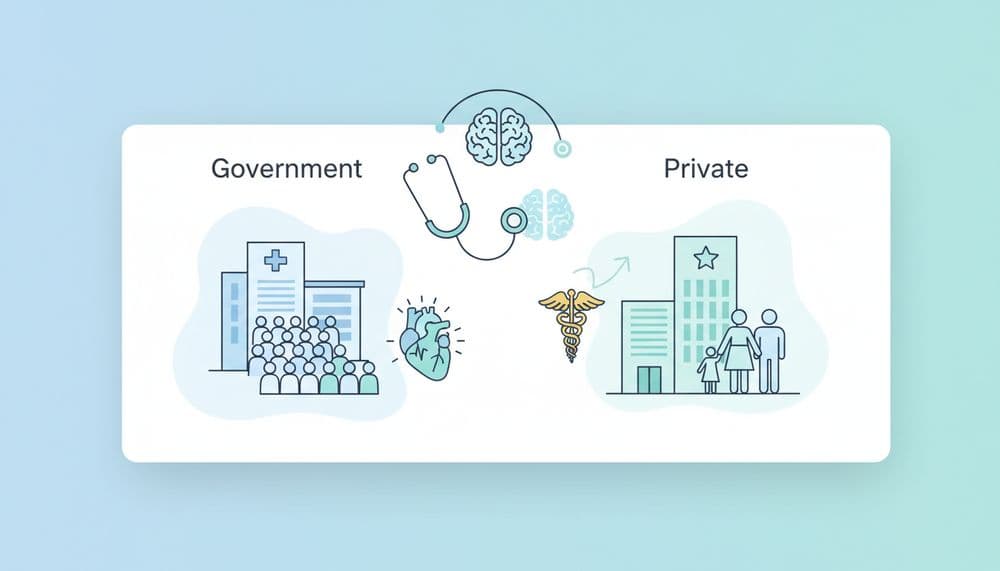
Arranging healthcare for parents in India from abroad is a significant responsibility, filled with complex decisions. One of the most fundamental choices is between a government and a private hospital. Each system offers a different balance of cost, speed, comfort, and perceived quality, making the decision deeply personal and dependent on your family's specific circumstances.
For Non-Resident Indians (NRIs) in the US, UK, Australia, or the Gulf, understanding the ground realities of both sectors is crucial. This guide provides a structured comparison to help you navigate this choice, using available data on costs, waiting times, quality indicators like accreditation, and the acceptance of major health schemes. Our aim is to equip you with the information needed to select a path that aligns with your parent's medical needs, your family's budget, and your expectations for care.
Government vs. Private Hospitals: Costs at a Glance (2025 Data)
Source: National Statistical Office (NSO) 2025 survey data. Costs are indicative and can vary significantly by city, hospital, and complexity of treatment.
- Average Inpatient Cost (Govt) — ₹6,631
- Average Inpatient Cost (Private) — ₹50,508
- Average Outpatient Cost (Govt) — ₹289
- Average Outpatient Cost (Private) — ₹1,447
- Ayushman Bharat (PM-JAY) Coverage — Up to ₹5 lakh per family per year
Rates shown are as per the National Statistical Office (NSO) health survey, Ministry of Statistics, Government of India (2025) and are subject to periodic revision. Always verify the latest approved rates on the official source.
Cost of Treatment: Subsidised Care vs. Market Pricing
The most significant difference between the two sectors is cost. Government hospitals offer services that are either free or heavily subsidised. A 2025 National Statistical Office (NSO) survey found the average cost for inpatient treatment in a public facility was ₹6,631. In contrast, the same survey reported an average inpatient cost of ₹50,508 in a private hospital—nearly eight times higher. The disparity holds for outpatient care as well, averaging ₹289 in government hospitals versus ₹1,447 in private ones.
Private hospital pricing is driven by commercial factors and can be 5 to 10 times higher than government facilities for similar treatments. Data from 2026 indicates an indicative average cost for private hospital treatment is around ₹1,20,000, with a range from ₹95,000 in Tier 2 cities to ₹2,20,000 in Tier 1 cities. While many larger private hospitals have structured pricing, costs can be unregulated in smaller establishments.
A useful objective benchmark for pricing is the Central Government Health Scheme (CGHS) rates. These are government-published prices for over 2,500 procedures that empanelled private hospitals agree to accept for CGHS beneficiaries. While not binding for other patients, these rates are sometimes used by courts as a reference for reasonable billing.
For specific procedures, the cost difference is stark. A private ward room in an X-category city under CGHS is capped at ₹4,500 per day, while private hospitals can charge much more. ICU charges under CGHS are set at ₹5,400 per day (all-inclusive), whereas private hospitals may charge up to ₹30,000 per day. For a unilateral knee replacement, the CGHS rate is around ₹95,000 - ₹1,00,000 (excluding the implant), compared to a typical private hospital price of ₹3,50,000 to ₹5,00,000. Similarly, an angioplasty that might cost ₹1,50,000 to ₹3,20,000 ($1,800 - $3,800) in the private sector would be covered at a much lower set rate under CGHS.
Waiting Times and Access to Care
The trade-off for low-cost care in government hospitals is often long waiting times. Due to extremely high patient volumes and resource constraints, queues are a common feature. For outpatient consultations, waits of 30-60 minutes are frequently reported. A 2025 study at AIIMS Patna recorded a mean waiting time of 50.43 minutes. The patient load can be so high that a Comptroller and Auditor General (CAG) report noted the average consultation time per patient at Delhi's Lok Nayak Hospital was less than five minutes.
For elective surgeries, the waiting lists can be extensive. A 2010 report from AIIMS, Delhi, revealed waits of six months to three years for neurosurgery. A 2022 CAG report found average waits of 2-3 months for general surgery and 6-8 months for plastic surgery at Lok Nayak Hospital. While some studies show shorter median waits, the potential for long delays for non-emergency procedures is a critical factor to consider.
In contrast, private hospitals offer significantly shorter waiting times. Appointments for consultations and procedures can typically be scheduled quickly. This speed is a primary reason many families opt for private care, especially for urgent conditions or time-sensitive elective surgeries. For procedures like angioplasty, many private hospitals can offer immediate appointments, providing prompt intervention when it is most needed.
Quality Signals: NABH Accreditation
For families seeking an objective measure of quality, the National Accreditation Board for Hospitals & Healthcare Providers (NABH) is India's principal quality standard. It is analogous to the JCI in the United States or the CQC in the UK. NABH accreditation is a voluntary process where a hospital is assessed against over 600 standards related to patient safety, clinical outcomes, and quality of care.
As of 2024-2026, there are over 1,400 hospitals with full NABH accreditation in India. While accreditation is open to all, including government facilities, small clinics, and rural centres, private hospitals are far more likely to be accredited. Public hospitals often find it challenging to meet the standards due to high patient loads and infrastructure limitations. The first public hospital was accredited in 2009.
NABH accreditation is a significant indicator of a hospital's commitment to quality. It is now a standard requirement for private hospitals to be empanelled under the Central Government Health Scheme (CGHS). Many multi-specialty private hospitals, particularly those catering to international patients, hold both NABH and Joint Commission International (JCI) accreditation. You can verify a hospital's status through the official NABH directory available at `portal.nabh.co`.
Navigating Government Schemes: PM-JAY and CGHS
Understanding your parents' eligibility for government health schemes is vital. The Pradhan Mantri Jan Arogya Yojana (PM-JAY), also known as Ayushman Bharat, is a major government-funded scheme providing a health cover of up to ₹5 lakh per family per year for secondary and tertiary care. As of September 2024, its coverage was expanded to include all senior citizens aged 70 and above, regardless of their income. While NRIs are not eligible, their resident parents may be. PM-JAY is accepted at all public hospitals (Community Health Centre and above) and a network of empanelled private hospitals. However, a 2023 study in Maharashtra noted that only about 13% of the state's private hospitals were part of the scheme.
The Central Government Health Scheme (CGHS) is for central government employees, pensioners, and their dependents. It provides cashless treatment at government-approved rates. All central government hospitals, like AIIMS and Safdarjung in Delhi, are part of the scheme. Additionally, a large network of over 1,500 private hospitals and diagnostic centres across 97 cities are 'empanelled' to provide services to CGHS beneficiaries at pre-defined rates. For planned treatment at an empanelled private hospital, a referral is typically required, though rules have been simplified. In an emergency, a beneficiary can go to any hospital, and the costs will be reimbursed at CGHS rates.
Hospital Environment: Attendants and Visitor Policies
The day-to-day experience within the hospital can greatly influence patient and family comfort. Government hospitals are often characterised by overcrowding. This can sometimes lead to less stringent enforcement of visitor policies, offering more flexibility for family attendants. However, it also means a less controlled, potentially less hygienic, and more chaotic environment.
Private hospitals generally enforce stricter, more formalised policies. It is standard practice to issue one attendant pass per patient for those in non-ICU rooms, allowing a family member to stay with the patient. For pediatric patients or those in suites, two passes may be issued. Visitation in Intensive Care Units (ICUs) is highly restricted, with a designated lobby area for one attendant. Specific visiting hours are enforced for other visitors, who are typically required to have a visitor pass. This structured approach creates a more controlled and quiet environment for patient recovery.
Making the Decision: When Each Sector Is a Better Fit
Choosing a government hospital is often the right decision when budget is the primary constraint. The care is highly affordable or free, making it accessible to everyone. It can also be a suitable choice if the medical condition is not urgent and your parent can manage a potentially long wait for an elective procedure or specialist appointment. Furthermore, certain government institutions, like AIIMS, are highly reputed for their specialized expertise in complex fields, drawing patients from all over the country.
A private hospital becomes the more practical choice when speed is critical. For urgent care, emergency procedures, or timely elective surgery, private facilities are significantly faster. They are also the preferred option when a certified standard of care is a priority; the presence of NABH or JCI accreditation provides an objective quality benchmark. If your parent has private health insurance with a wide network or is a CGHS beneficiary seeking care at a specific empanelled private hospital, the private sector offers more options. Finally, if patient comfort, privacy, a controlled environment, and better amenities are important for your parent's well-being and recovery, a private hospital is the better fit, provided the cost is manageable through insurance or self-funding.
More guides for NRIs and international patients
Related guides from our NRI and international patient hub:
- A Guide to Health Insurance for NRIs Returning to India
- Ayushman Card for Senior Citizens: A Guide for NRIs
- A Guide to Health Insurance for NRIs & OCIs Visiting India
- Online Second Opinion from Indian Specialists: An NRI Guide
- Healthcare in India for NRIs and international patients: all guides
Frequently Asked Questions
Can my parents use Ayushman Bharat (PM-JAY) if I am an NRI?
As an NRI, you are not eligible for PM-JAY. However, your parents residing in India may be eligible. Since September 2024, the scheme has been expanded to cover all senior citizens aged 70 and above, regardless of income. You should check their specific eligibility based on the scheme's criteria.
How much does a knee replacement cost in a private vs. government hospital in India?
There is a substantial cost difference. In a private hospital, a unilateral knee replacement typically costs between ₹3,50,000 and ₹5,00,000. Under the Central Government Health Scheme (CGHS) rates, which can be a benchmark, the procedure is priced around ₹95,000 - ₹1,00,000, excluding the implant. The cost in a general government hospital would be even lower, often heavily subsidised.
Are wait times for surgery in Indian government hospitals really months long?
Yes, for certain elective procedures, wait times can be extensive. For example, reports have shown waiting lists for neurosurgery at AIIMS, Delhi, ranging from six months to three years. A 2022 report noted waits of 6-8 months for plastic surgery at another major Delhi hospital. These delays are due to high patient volume and resource limitations. Emergency surgeries are performed without such delays.
How can I verify if a private hospital in India has good quality standards?
A reliable method is to check for NABH (National Accreditation Board for Hospitals & Healthcare Providers) accreditation. This is India's primary quality standard. You can verify a hospital's accreditation status on the official NABH website at portal.nabh.co. For hospitals catering to international patients, you can also look for JCI (Joint Commission International) accreditation.
If my father is a CGHS beneficiary, can he go to a private hospital for treatment?
Yes. The Central Government Health Scheme (CGHS) has a large network of empanelled private hospitals and diagnostic centres. A CGHS beneficiary can receive treatment at these facilities at pre-defined government rates. For planned procedures, a referral from a CGHS Wellness Centre or government specialist is usually required. In an emergency, he can go to any hospital for treatment.
What are the typical rules for staying with my parent as an attendant in an Indian hospital?
Rules vary between government and private hospitals. In private hospitals, it is common to issue one attendant pass per patient, allowing one family member to stay overnight in the room (for non-ICU patients). ICUs have much stricter rules, usually not allowing anyone inside except during brief, specified visiting hours. Government hospitals tend to be more crowded and may have more lenient, less strictly enforced rules, but the environment is less controlled.
Related
- Healthcare in India for NRIs and international patients: the complete hub
- Treatment costs in India: a complete guide
- How to find an Ayushman Bharat (PM-JAY) hospital near you
- Government health schemes in India: a guide
Medical Disclaimer
The information provided in this article is for general informational and educational purposes only. It is not intended as a substitute for professional medical advice, diagnosis, or treatment. Always seek the advice of your physician or other qualified healthcare provider with any questions you may have regarding a medical condition. Never disregard professional medical advice or delay in seeking it because of something you have read in this article.
Top doctors on Zospital
Verified specialists you can book in minutes.
- Book appointment

Dr. Naina Gupta
Oncologist
Varanasi
Verified•4 - Book appointment

Dr. Vishwanath Pratap Singh
General Surgeon
Varanasi
Verified•4.9 - Book appointment
Dr N. S . Paliwal
Rehabilitation Specialist
Lucknow
Verified - Book appointment

Dr. Roli Purwar
Gynecologist
Gorakhpur
Verified - Book appointment

Dr. Abhinav Srivastava
Spine Surgeon
Lucknow
Verified•4.9 - Book appointment

Dr. Shoeb Arif Khan
Orthopedic Surgeon
Lucknow
Verified•4.9
Have More Questions?
Find quick answers to common questions about our services, appointments, and patient care.
As an NRI, you are not eligible for PM-JAY. However, your parents residing in India may be eligible. Since September 2024, the scheme has been expanded to cover all senior citizens aged 70 and above, regardless of income. You should check their specific eligibility based on the scheme's criteria.
There is a substantial cost difference. In a private hospital, a unilateral knee replacement typically costs between ₹3,50,000 and ₹5,00,000. Under the Central Government Health Scheme (CGHS) rates, which can be a benchmark, the procedure is priced around ₹95,000 - ₹1,00,000, excluding the implant. The cost in a general government hospital would be even lower, often heavily subsidised.
Yes, for certain elective procedures, wait times can be extensive. For example, reports have shown waiting lists for neurosurgery at AIIMS, Delhi, ranging from six months to three years. A 2022 report noted waits of 6-8 months for plastic surgery at another major Delhi hospital. These delays are due to high patient volume and resource limitations. Emergency surgeries are performed without such delays.
A reliable method is to check for NABH (National Accreditation Board for Hospitals & Healthcare Providers) accreditation. This is India's primary quality standard. You can verify a hospital's accreditation status on the official NABH website at portal.nabh.co. For hospitals catering to international patients, you can also look for JCI (Joint Commission International) accreditation.
Yes. The Central Government Health Scheme (CGHS) has a large network of empanelled private hospitals and diagnostic centres. A CGHS beneficiary can receive treatment at these facilities at pre-defined government rates. For planned procedures, a referral from a CGHS Wellness Centre or government specialist is usually required. In an emergency, he can go to any hospital for treatment.
Rules vary between government and private hospitals. In private hospitals, it is common to issue one attendant pass per patient, allowing one family member to stay overnight in the room (for non-ICU patients). ICUs have much stricter rules, usually not allowing anyone inside except during brief, specified visiting hours. Government hospitals tend to be more crowded and may have more lenient, less strictly enforced rules, but the environment is less controlled.
Related Articles

Jaipur Anesthesiologist: What Patients See Before They Call
Patients in Jaipur now search for anesthesiologists online using Google and WhatsApp. Learn how a free Zospital profile helps them find and book with your practice.

Lucknow Anesthesiologist: A 5-Minute Online Profile
Learn how Lucknow patients search for anesthesiology services and how a simple online profile can connect them directly to your practice.

New Delhi Anesthesiologists: Be Seen Where Patients Are Looking
Your expertise as an Anesthesiologist in New Delhi is undeniable, but are local patients able to find you online? Discover how a simple online profile can connect you with patients actively seeking care.
Written by Dr. Nikhil Singh
Last reviewed: 14 August 2026
Medical Disclaimer
The content provided on Zospital is for general informational and educational purposes only. It is not intended as a substitute for professional medical advice, diagnosis, or treatment. Always seek the advice of your physician or other qualified healthcare provider with any questions you may have regarding a medical condition. Never disregard professional medical advice or delay in seeking it because of something you have read on this website. If you think you may have a medical emergency, call your doctor or emergency services immediately.
Are you a doctor or run a clinic or hospital?
Patients across India are searching Zospital right now. Get a free profile with reviews, timings and direct WhatsApp bookings.