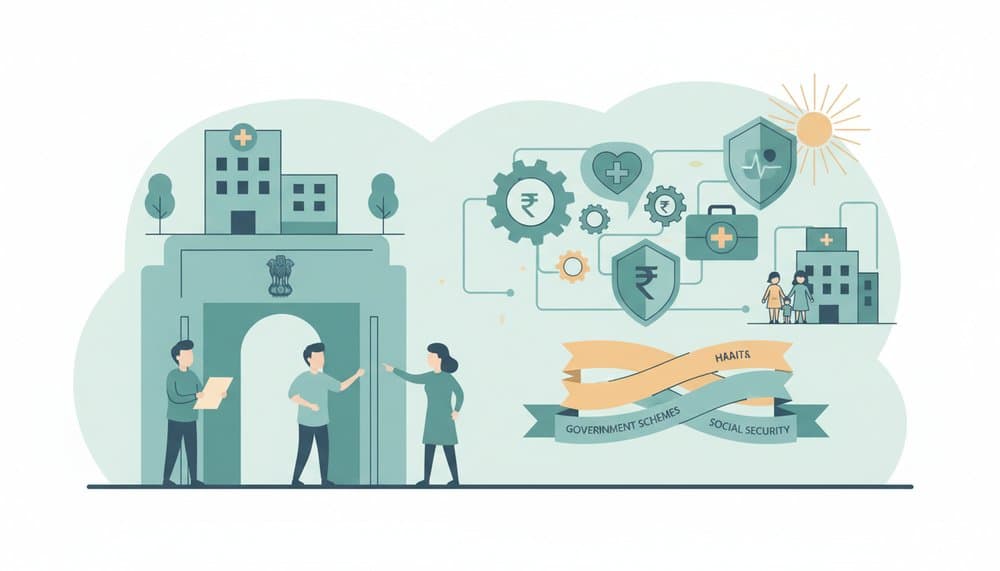
Government Schemes & Social Security: Complete Guide
Medically reviewed by Dr.Nikhil Singh, Anaesthesia, MBBS, MD
Last reviewed: 16 Aug 2026
A Comprehensive Guide to India's Government Healthcare Schemes: Ayushman Bharat, CGHS, ESIC, and ECHS
Navigating the landscape of healthcare in India is made significantly more accessible through a range of government-sponsored health schemes. These initiatives are designed to provide comprehensive medical coverage to various segments of the population, from the economically vulnerable to government employees and armed forces veterans. This guide offers an in-depth overview of four key schemes: Ayushman Bharat Pradhan Mantri Jan Arogya Yojana (PM-JAY), the Central Government Health Scheme (CGHS), the Employees' State Insurance Corporation (ESIC) scheme, and the Ex-Servicemen Contributory Health Scheme (ECHS). Understanding the eligibility, benefits, and application processes for each is crucial for accessing the healthcare support you and your family may be entitled to.
Ayushman Bharat Pradhan Mantri Jan Arogya Yojana (PM-JAY): Healthcare for the Economically Vulnerable
Launched in 2018, Ayushman Bharat PM-JAY is the world's largest government-funded health assurance scheme. It aims to provide a health cover of ₹5 lakh per family per year for secondary and tertiary care hospitalization to over 12 crore poor and vulnerable families. The scheme is designed to be cashless and paperless, offering a safety net against catastrophic medical expenditure.
Overview of Sub-topics
Eligibility Criteria: Eligibility for PM-JAY is primarily based on the Socio-Economic Caste Census (SECC) 2011 data for both rural and urban areas.
- For Rural Areas: The scheme targets households with specific deprivation criteria, such as those without shelter, landless households deriving a major part of their income from manual casual labor, and households with no adult male member between the ages of 16 and 59.
- For Urban Areas: Eligibility is based on occupational categories, including ragpickers, beggars, domestic workers, street vendors, and construction workers.
- Recent Expansion: The scheme has been expanded to include all senior citizens aged 70 and above, regardless of their economic status.
Key Benefits:
- Financial Protection: Provides a health cover of up to ₹5 lakh per family per year on a family floater basis.
- Comprehensive Coverage: The scheme covers over 1,900 medical procedures, including costs related to diagnostics, medicines, room charges, and surgeon's fees. It also includes up to 3 days of pre-hospitalization and 15 days of post-hospitalization expenses.
- Cashless and Paperless Access: Beneficiaries can avail of cashless treatment at any empanelled public or private hospital across the country.
- No Cap on Family Size or Age: The benefits are available to all eligible family members, with no restrictions on family size, age, or gender.
- Pre-existing Conditions: All pre-existing diseases are covered from day one of enrollment.
Central Government Health Scheme (CGHS): Comprehensive Care for Government Employees
Established in 1954, the Central Government Health Scheme (CGHS) is a comprehensive healthcare program for Central Government employees, pensioners, and their dependents. It operates on a contribution-based model and provides services through a network of wellness centers (dispensaries), polyclinics, and empanelled government and private hospitals in designated cities.
Overview of Sub-topics
Eligibility Criteria:
- Serving Employees: All Central Government employees paid from the Central Civil Estimates and their dependent family members are eligible.
- Pensioners: Central Government pensioners and their families are eligible to join the scheme.
- Other Beneficiaries: The scheme also extends to Members of Parliament, judges, freedom fighters, accredited journalists, and certain other categories.
- Dependents: Coverage includes the spouse, dependent parents (with an income below ₹9,000 per month plus dearness relief), and unmarried children up to the age of 25.
Provisions for NRIs: The CGHS does not cover medical expenses incurred outside of India. However, retired central government pensioners living abroad can keep their CGHS card active by paying a subscription. This allows their eligible dependents residing in India to continue accessing full CGHS benefits, and the pensioner can use the facilities during visits to India. As an alternative, pensioners in non-CGHS areas (including abroad) can opt for a Fixed Medical Allowance (FMA) of ₹1,000 per month for outpatient expenses, but this can only be switched with the full CGHS membership once in a lifetime.
Key Benefits:
- Outpatient (OPD) and Inpatient (IPD) Care: The scheme covers OPD consultations and the issuance of medicines through its wellness centers, as well as inpatient treatment at empanelled hospitals.
- Cashless Facility: Cashless treatment is available at empanelled hospitals for beneficiaries.
- AYUSH Treatment: CGHS covers treatments under Ayurveda, Yoga, Unani, Siddha, and Homeopathy through designated centers.
- Wide Range of Services: Benefits include diagnostic tests, specialist consultations, and coverage for chronic illnesses.
Employees' State Insurance Corporation (ESIC): Social Security for the Workforce
The Employees' State Insurance (ESI) scheme is a self-financing social security and health insurance program for Indian workers. Managed by the Employees' State Insurance Corporation (ESIC), it provides a combination of medical care and cash benefits to insured employees and their families. The scheme is contributory, with both employers and employees making regular contributions.
Overview of Sub-topics
Eligibility Criteria:
- Applicability: The scheme applies to non-seasonal factories and other establishments with 10 or more employees (20 or more in some states).
- Wage Ceiling: Employees with monthly wages up to ₹21,000 are eligible for coverage. For persons with disabilities, the wage limit is ₹25,000.
- Contribution: The employer contributes 3.25% of the wages, while the employee contributes 0.75%. Employees earning a daily average wage of up to ₹176 are exempt from their contribution.
Key Benefits:
- Medical Benefits: Insured persons and their dependents are entitled to comprehensive medical care from the first day of employment through a network of ESI hospitals, dispensaries, and empanelled private hospitals.
- Sickness Benefit: Cash compensation at the rate of 70% of wages is payable to insured workers during periods of certified sickness for up to 91 days in a year.
- Maternity Benefit: Pregnant women are entitled to paid leave and a cash benefit for a specified period.
- Disablement Benefit: In case of temporary or permanent disablement due to an employment injury, a monthly cash benefit is provided.
- Unemployment Allowance: Insured persons who become unemployed may receive an allowance for up to two years.
Ex-Servicemen Contributory Health Scheme (ECHS): Dedicated to Our Veterans
Launched in 2003, the Ex-Servicemen Contributory Health Scheme (ECHS) is a flagship healthcare program of the Government of India for veterans of the Armed Forces and their dependents. It is a contributory scheme that provides comprehensive medical care through a network of ECHS polyclinics, service hospitals, and empanelled private hospitals across the country.
Overview of Sub-topics
Eligibility Criteria:
- Ex-Servicemen Pensioners: The scheme is open to all ex-servicemen who are in receipt of a pension or disability pension from the Controller of Defence Accounts.
- Dependents: Eligible dependents include the spouse, unmarried/unemployed daughters, unemployed sons up to the age of 25, and dependent parents whose income is less than ₹9,000 per month plus DA.
- Mandatory Enrollment: Membership became mandatory for all pensioners who retired on or after April 1, 2003.
Key Benefits:
- Comprehensive Medical Coverage: ECHS covers all known diseases and provides for outpatient and inpatient treatment, specialist consultations, diagnostic tests, and medicines.
- Cashless Treatment: Beneficiaries can avail of cashless treatment at ECHS polyclinics and empanelled hospitals using their ECHS Smart Card.
- One-Time Contribution: Members are required to make a one-time contribution at the time of joining, which varies based on their rank at retirement. There are no recurring premiums.
- No Monetary Ceiling: There is no cap on the expenditure for treatment, ensuring that veterans receive the necessary care without financial limitations.
- Nationwide Accessibility: The scheme is accessible through a wide network of 427 polyclinics and numerous empanelled healthcare facilities across India.
When to Seek Treatment: A Practical Guide
Navigating the process of seeking treatment under these schemes involves a few key steps:
- Ayushman Bharat (PM-JAY): Beneficiaries can directly visit any empanelled hospital for treatment. At the hospital's help desk, the "Ayushman Mitra" will verify your eligibility using your PM-JAY ID or Aadhaar number, after which the cashless treatment process is initiated.
- CGHS: For outpatient care, beneficiaries should first visit their designated CGHS Wellness Centre for consultation and medicines. For specialist consultations or hospitalization, a referral from the Wellness Centre is typically required to proceed to an empanelled hospital.
- ESIC: The first point of contact is usually an ESI dispensary or an Insurance Medical Practitioner (IMP). A referral is generally needed for specialist treatment or hospitalization at an ESI or empanelled hospital. However, in areas without an ESIC health facility within 10 km, beneficiaries can directly visit an empanelled hospital for OPD services.
- ECHS: For outpatient services,
Written by
Top Anesthesiologist doctors in Lucknow on Zospital
Verified specialists you can book in minutes.
- Book appointment

Dr. Sanni Deyol Gautam
Anesthesiologist
Lucknow
4.8 - Book appointment

Dr Karanvir Singh Sidhu
Anesthesiologist
Lucknow
4.8 - Book appointment

Dr Harpreet Kaur
Anesthesiologist
Lucknow
4.8 - Book appointment

Dr. Akshat Trivedi
Anesthesiologist
Lucknow
4.5 - Book appointment
Dr. Praful Srivastava
Anesthesiologist
4.8 - Book appointment
Dr. Mohd. Ruheel Khan
Anesthesiologist
Faizabad

“Your Health, Our Priority. Your Voice, Our Guide”
Dr.Nikhil Singh
Anaesthesia, MBBS, MD
Private hospitals in Lucknow on Zospital
Prefer a private option? These hospitals in Lucknow list their doctors and take bookings.
See all hospitals in LucknowRelated Articles
Government Stanley Medical College Hospital, Chennai: Appointment and OPD Guide
A guide to getting an OPD appointment, understanding costs, and accessing government schemes at Government Stanley Medical College Hospital in Chennai, Tamil Nadu.
Government vs. Private Hospitals in India: An NRI's Guide for Parents
Compare costs, wait times, quality & schemes between government and private hospitals in India to choose the right care for your parents. An NRI decision guide.

Jaipur Anesthesiologist: What Patients See Before They Call
Patients in Jaipur now search for anesthesiologists online using Google and WhatsApp. Learn how a free Zospital profile helps them find and book with your practice.
Written by Dr.Nikhil Singh
Anaesthesia, MBBS, MD
Last reviewed: 16 August 2026
Medical Disclaimer
The content provided on Zospital is for general informational and educational purposes only. It is not intended as a substitute for professional medical advice, diagnosis, or treatment. Always seek the advice of your physician or other qualified healthcare provider with any questions you may have regarding a medical condition. Never disregard professional medical advice or delay in seeking it because of something you have read on this website. If you think you may have a medical emergency, call your doctor or emergency services immediately.
Are you a doctor or run a clinic or hospital?
Patients across India are searching Zospital right now. Get a free profile with reviews, timings and direct WhatsApp bookings.