Emergency Healthcare Abroad: Complete Guide
Medically reviewed by Dr. Nikhil Singh, Anaesthesia, MBBS, MD
Last reviewed: 24 Aug 2026
An NRI's Comprehensive Guide to Navigating Global Medical Emergencies
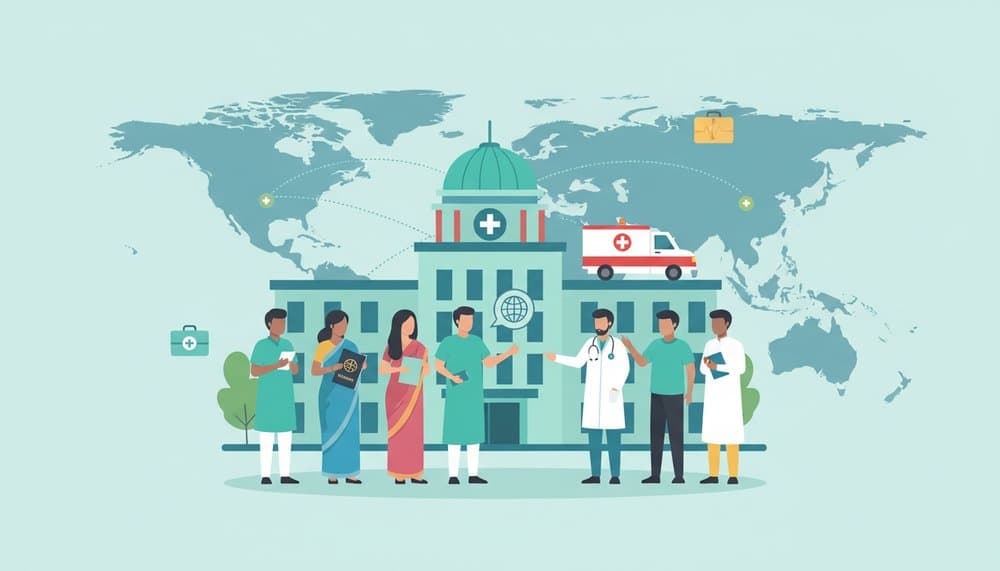
For Non-Resident Indians (NRIs), the world is a landscape of opportunity, connection, and growth. Yet, this global lifestyle carries a unique set of challenges, none more critical than navigating a medical emergency. Whether it involves you, a visiting family member, or a loved one back in India, being prepared can make all the difference. This guide offers a comprehensive overview of emergency healthcare for NRIs, covering everything from on-ground protocols in different countries to managing crises from thousands of miles away.
A medical emergency can be a disorienting experience, amplified by unfamiliar healthcare systems, language barriers, and the stress of being far from home. For the nearly 30 million NRIs worldwide, these situations can trigger a cascade of logistical, financial, and emotional challenges. This guide is designed to be your first point of reference, a playbook to help you, your visiting parents, or your family in India handle health crises with clarity and confidence.
Key Section 1: Understanding Emergency Protocols Abroad
When a medical crisis strikes in a foreign country, knowing the correct emergency number is the first and most critical step. These numbers are not universal, and dialing the wrong one can lead to dangerous delays.
Overview of Sub-topics:
- Country-Specific Emergency Numbers: A detailed list of emergency contacts for countries with large NRI populations.
- Communicating with First Responders: Tips for conveying essential information clearly, especially when facing a language barrier.
- Navigating Local Hospitals: Understanding the difference between public and private facilities and what to expect upon admission.
Emergency Numbers in Key Countries:
While many travelers instinctively think of "911," this number is specific to North America. Here is a brief list of emergency numbers in countries with significant Indian populations:
- United States & Canada: 911 is the universal number for police, fire, and ambulance services.
- United Kingdom: 999 is the primary emergency number. You can also use 112.
- European Union: 112 is the standard emergency number across all EU member states and can be dialed from any phone, free of charge.
- Australia: 000 is the national emergency number for all services.
- United Arab Emirates (UAE): 999 is the number for police, and 998 is for an ambulance.
- India: 112 is the all-in-one emergency helpline, while 102 or 108 is for ambulances, and 100 is for the police.
It is crucial to save these numbers in your phone before you travel and carry a physical copy. In many countries, GSM mobile phones may automatically redirect a "911" call to the local emergency number, but this is not a foolproof system.
Key Section 2: Managing a Loved One's Emergency from a Distance
One of the greatest sources of anxiety for NRIs is the thought of a parent or family member falling ill back in India. Getting a call about a hospitalization in a different time zone can be frightening, but with a clear plan, you can manage the situation effectively.
Overview of Sub-topics:
- Building a Local Support System: The importance of having trusted contacts in India.
- Leveraging Telemedicine: How to use technology for consultations and second opinions.
- Coordinating with Hospitals Remotely: A checklist for getting clear information and ensuring quality care.
Immediate Steps and Long-Term Preparation:
The first 30 minutes of an emergency are crucial. If a loved one is hospitalized in India, your immediate goal is to gather information: the hospital's name and address, the doctor's name, and the initial diagnosis. The single most important action is to activate your local support network—a trusted neighbor, relative, or friend who can be physically present at the hospital.
For long-term preparedness, consider the following:
- Centralize Medical Records: Use digital health apps to store prescriptions, test results, and medical history in one accessible place. This ensures that critical information is available to doctors in an emergency.
- Embrace Telemedicine: Services like eSanjeevani (the government's free platform) and private paid platforms allow for remote consultations with Indian doctors. While NRIs may not be able to directly join a call on the eSanjeevani platform, private services often facilitate three-way calls with the patient's consent, enabling you to participate in medical discussions.
- Establish an Emergency Protocol: Create a clear plan with your local contacts in India. This should include knowing the nearest multi-specialty hospital, having the family doctor's number on hand, and knowing which ambulance service to call (the government-run 108 service is widely available and free).
Key Section 3: Navigating Emergency Healthcare Costs
Medical treatment abroad, particularly in Western countries, can be prohibitively expensive. A single night in a U.S. hospital can cost between $5,000 and $15,000, and a major procedure like appendix surgery can run from $30,000 to $50,000. Without adequate insurance, a medical emergency can quickly become a financial catastrophe.
Overview of Sub-topics:
- The High Cost of Global Healthcare: A breakdown of potential emergency costs in different regions.
- Health Insurance for NRIs: Options for securing coverage for yourself and your family in India.
- Travel Insurance vs. Health Insurance: Understanding the difference and why you might need both.
Insurance Options for NRIs:
NRIs have several options for managing healthcare costs:
- Health Insurance in India: NRIs are eligible to purchase health insurance policies in India, which cover medical expenses incurred within the country. These plans are ideal for NRIs who visit India frequently or have family residing there. Premiums can often be paid from NRE or NRO accounts, and NRIs can even avail tax benefits under Section 80D of the Income Tax Act.
- International Travel Insurance: This is essential for covering medical emergencies that occur outside your country of residence. When purchasing a policy, ensure it includes robust coverage for hospitalization, emergency evacuation, and repatriation.
- Indian Community Welfare Fund (ICWF): For Indian citizens in dire distress abroad, the ICWF, administered by the Ministry of External Affairs through its embassies, can provide financial assistance for medical emergencies.
It's important to note that most standard health insurance policies purchased in India only cover treatments within India. If you have a foreign insurance plan, it may offer limited or no coverage in India.
Key Section 4: Medical Evacuation and Repatriation
In a severe medical crisis, you or a loved one might need to be transported to a location with better medical facilities or back to your home country. This is where medical evacuation (medevac) and medical repatriation services become vital.
Overview of Sub-topics:
- Understanding Medevac and Repatriation: The difference between the two and when they are necessary.
- The Logistics of Air Ambulances: What is involved in arranging a medical flight.
- Costs and Insurance Coverage: The financial implications of medical transport.
Options for Getting Back to India:
- Medical Evacuation (Medevac): This involves urgently moving a patient from a location with inadequate medical care to a facility that can provide life-saving treatment.
- Medical Repatriation: This refers to returning a patient to their home country for continued treatment or recovery. Many NRIs prefer this for the comfort of being in a familiar healthcare system and having family support.
The cost of an air ambulance can be staggering, ranging from $25,000 to over $250,000, depending on the distance, the patient's condition, and the type of aircraft required. It is crucial to have travel or health insurance that explicitly covers medical evacuation and repatriation. Companies specializing in air medical transport can often arrange a flight within a day, coordinating everything from ground transport to medical clearances.
Key Section 5: Essential Emergency Documentation
In the midst of a crisis, having the right documents readily available can save precious time and prevent immense stress. This applies to both medical and travel-related emergencies.
Overview of Sub-topics:
- The "Go-Bag" of Medical Documents: What to carry with you at all times.
- Losing Your Passport Abroad: The process for getting an Emergency Certificate.
- Digital vs. Physical Copies: Best practices for storing and accessing important documents.
Must-Have Documents:
- Medical Information: Always carry a note from your doctor detailing any pre-existing conditions, a list of your regular medications (with generic names), and any known allergies. It's also wise to have digital copies of recent medical reports and prescriptions stored in a cloud folder accessible to a family member.
- Passport and Visas: Keep photos of your passport's bio-page, visa stamps, and other important documents on your phone and in the cloud. This can significantly speed up the process of getting help if your documents are lost or stolen.
- Emergency Certificate (EC): If you are an Indian citizen and lose your passport abroad, you must first file a police report. Then, contact the nearest Indian Embassy or High Commission to apply for an Emergency Certificate. An EC is a one-way travel document that allows you to return to India. The application typically requires the police report, proof of identity, and your travel itinerary.
When to Seek Emergency Treatment
Recognizing a medical emerge
Top Anesthesiologist doctors in Lucknow on Zospital
Verified specialists you can book in minutes.
- Book appointment

Dr. Sanni Deyol Gautam
Anesthesiologist
Lucknow
4.8 - Book appointment

Dr Karanvir Singh Sidhu
Anesthesiologist
Lucknow
4.8 - Book appointment

Dr Harpreet Kaur
Anesthesiologist
Lucknow
4.8 - Book appointment

Dr. Akshat Trivedi
Anesthesiologist
Lucknow
4.5 - Book appointment
Aveline Pascual Jerome, MD
Anesthesiologist
Ajmer
5 - Book appointment
Dr. Vivek Kumar Sharma - Laser & Advanced Laparoscopy Surgeon In Ajmer
Anesthesiologist
Ajmer
4.7

“Your Health, Our Priority. Your Voice, Our Guide”
Dr. Nikhil Singh
Anaesthesia, MBBS, MD
Private hospitals in Lucknow on Zospital
Prefer a private option? These hospitals in Lucknow list their doctors and take bookings.
- Paarth Eye Hospital & Retina Centre
- Urmila Devi Memorial Hospital- Child Specialist Hospital in Lucknow | Pediatrician hospital
- SPARSH CHILDREN'S HOSPITAL & VACCINATION CENTER | Child Hospital in Raebareli Road Lucknow | Dr. Akhilesh Pandey |
Related Articles

Navigating Medical Emergencies Abroad: A Healthcare Guide for NRIs
This guide assists NRIs with emergency healthcare abroad in the USA, UK, Canada, UAE, and Australia. Understand ambulance, ER, insurance, and costs.

Emergency Healthcare Abroad for Indian Patients & NRIs
Understand emergency healthcare costs and insurance for Indian patients and NRIs abroad. Navigate foreign healthcare systems and prevent financial burden.
Emergency Numbers for Indians Abroad: Protocols & Costs
This guide provides Indian citizens and NRIs with practical information on medical emergency protocols, costs, and hospital navigation abroad.

Written by Dr. Nikhil Singh
Anaesthesia, MBBS, MD
Last reviewed: 24 August 2026
Medical Disclaimer
The content provided on Zospital is for general informational and educational purposes only. It is not intended as a substitute for professional medical advice, diagnosis, or treatment. Always seek the advice of your physician or other qualified healthcare provider with any questions you may have regarding a medical condition. Never disregard professional medical advice or delay in seeking it because of something you have read on this website. If you think you may have a medical emergency, call your doctor or emergency services immediately.
Are you a doctor or run a clinic or hospital?
Patients across India are searching Zospital right now. Get a free profile with reviews, timings and direct WhatsApp bookings.