CGHS Knee Replacement Rules: Your 2024 Guide
Medically reviewed by Dr. Abhinav Srivastava, Orthopaedic Surgeon, MBBS, MS
Last reviewed: 9 Aug 2026
Living with chronic knee pain can be incredibly challenging, affecting everything from daily chores to cherished family time. For many in North India, especially our respected elders, the thought of surgery can be daunting, not just medically but financially. Thankfully, the Central Government Health Scheme (CGHS) provides significant relief. However, understanding the specific CGHS rules for knee replacement surgery is the first step towards a pain-free life. This guide will walk you through everything you need to know.
Does CGHS Cover Knee Replacement Surgery?
Let's start with the most important question: Yes, knee replacement surgery is covered under CGHS. According to official guidelines and information from empanelled hospitals, both traditional and even advanced procedures like robotic knee replacement are included for eligible beneficiaries. This is a massive relief for government employees and pensioners who rely on the scheme for their healthcare needs. The scheme aims to make essential procedures accessible without causing financial distress, ensuring you pay little to no out-of-pocket cost for approved treatments at empanelled hospitals.
Understanding CGHS Package Rates for Knee Surgery
To standardize costs and ensure transparency, CGHS predefines package rates for various procedures, including Total Knee Replacement (TKR). These rates are fixed and cover a bundle of services associated with the surgery.
What do the package rates include?
Typically, the CGHS package rate for knee replacement covers:
- Hospital Stay: This includes room charges (as per ward entitlement), nursing care, and meals.
- Surgeon's Fees: The cost of the orthopedic surgeon and their team.
- Anesthetist's Fees: Charges for the anesthesia and monitoring during the procedure.
- Operation Theatre Charges: Costs associated with using the surgical facilities.
- Basic Implants: The cost of the standard, approved knee implant.
- Medicines and Consumables: All necessary medications, bandages, and other consumables during the hospital stay.
- Post-operative Care: Initial follow-up consultations and care immediately after the surgery.
As per government circulars, CGHS has prescribed specific rates for the surgery itself. For example, a circular mentioned rates of approximately ₹1,26,500 for NABH-accredited hospitals and ₹1,10,000 for non-NABH hospitals for the Total Knee Replacement procedure. It's crucial to remember that these figures are for the procedure and associated costs; the implant costs are often considered separately under a different ceiling.
The Approval Process: A Step-by-Step Guide
Navigating the paperwork is often the most confusing part. Here’s a simplified breakdown of the typical approval process under CGHS rules for knee replacement.
Step 1: Specialist Consultation
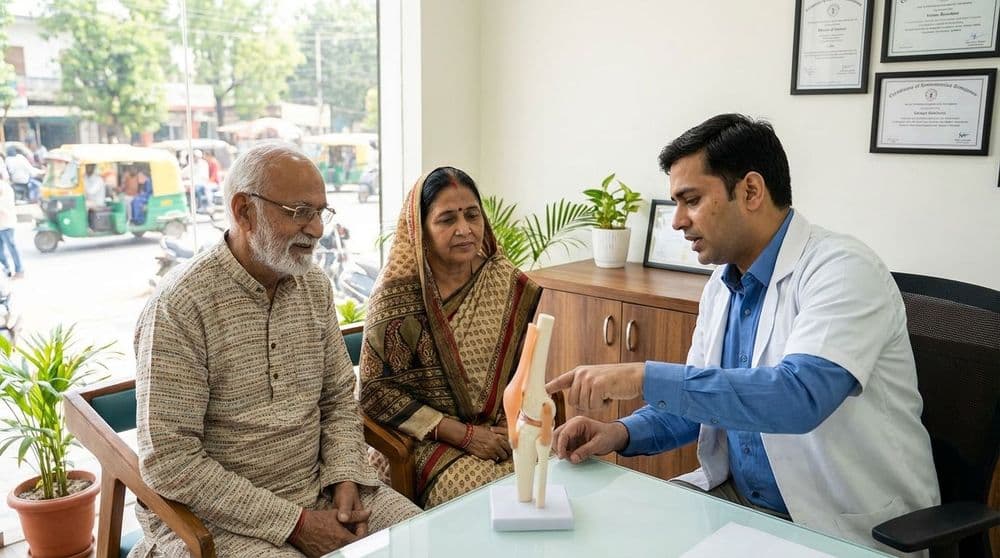
Your journey begins with a consultation with an Orthopedic specialist at a government or CGHS-empanelled private hospital. The specialist will conduct a thorough medical evaluation, including reviewing your health history and examining your knee's mobility and function.
Step 2: Diagnosis and Recommendation
To confirm the need for surgery, the doctor will order imaging tests like X-rays and, if needed, an MRI. These tests provide a detailed look at the joint damage. If conservative treatments like medication and physiotherapy ('desi nuskhe' or home remedies are no longer working), the specialist will officially recommend a Total Knee Replacement.
Step 3: Getting Approval
With the specialist's recommendation, you will need to get prior permission from the relevant CGHS authorities. This involves submitting the required forms, the doctor's prescription, and diagnostic reports to your parent department or the CGHS wellness center. This step is critical for ensuring a cashless or reimbursement-based procedure.
Step 4: Admission to an Empanelled Hospital
Once you have the approval letter, you can get admitted to a CGHS-empanelled hospital of your choice in cities like Delhi, Lucknow, or Varanasi. The hospital's CGHS desk will handle the paperwork and coordinate with the authorities for a smooth, cashless experience.
Implant Costs: The Fine Print in CGHS Rules
This is one of the most important aspects to understand. While CGHS covers the surgery, there is often a ceiling rate or capping on the cost of the knee implant itself. The scheme has approved rates for standard Indian and imported implants.
If your surgeon recommends a premium or specialized implant that costs more than the CGHS-approved ceiling, you may have to bear the differential cost. It is essential to have a clear discussion with your doctor and the hospital administration about the type of implant being used and any potential extra costs before the surgery. This transparency ensures there are no surprises when it comes to the final bill.
Robotic Knee Replacement: Is it Covered?
Yes, the good news is that modern advancements are also included. Several sources confirm that robotic knee replacement surgery is fully covered under CGHS for eligible beneficiaries. This advanced technique offers greater precision in placing the implant, potentially leading to better outcomes, a more natural-feeling knee, and a quicker recovery. If you are considering this option, ensure the hospital you choose is empanelled with CGHS for robotic surgical procedures.
Living with knee pain shouldn't be a life sentence. By understanding the CGHS rules for knee replacement, you can confidently take the next step towards regaining your mobility and enjoying a better quality of life. Always verify the latest circulars and consult with the hospital's CGHS helpdesk for the most current information.
Experiencing persistent symptoms? Consult Dr. Sandeep Kr. Garg, a leading Orthopedic Surgeon in your area. Book Appointment
Related reading
Written by
Top Orthopedics doctors in Lucknow on Zospital
Verified specialists you can book in minutes.
- Book appointment

Dr. Shoeb Arif Khan
Orthopedic Surgeon
Lucknow
Verified•4.9 - Book appointment
Dr. Udbhav Agarwal
Orthopedic Surgeon
Prayagraj
Verified•4.1 - Book appointment

Dr. Mrinal Jaiswal
Orthopedic Surgeon
Varanasi
Verified•4.9 - Book appointment

Dr. Krunal Soni
Orthopaedic surgeon
Ahmedabad
4.9 - Book appointment
Dr. Saurabh Goyal
Orthopaedic surgeon
Ahmedabad
4.9 - Book appointment

Dr. Ateet Sharma
Orthopaedic surgeon
Ahmedabad
5
Have More Questions?
Find quick answers to common questions about our services, appointments, and patient care.
Yes. Robotic knee replacement surgery is fully covered under CGHS for eligible beneficiaries. The knee replacement surgery CGHS rate is predefined under the official CGHS rate list, ensuring patients pay zero out-of-pocket cost for approved procedures.
Besides CGHS for government employees, the Ayushman Bharat – Pradhan Mantri Jan Arogya Yojana (AB-PMJAY) offers eligible families cashless health coverage up to Rs. 5 lakh per year, which includes procedures like knee replacement.
Approval starts with a medical evaluation by a specialist. This includes reviewing your health history and performing imaging tests like X-rays or MRIs. Based on these, the surgeon will recommend the surgery, which is then submitted to CGHS for official approval.
The cost of knee replacement surgery in India can range from ₹1,50,000 to ₹6,00,000. However, under schemes like CGHS or in government hospitals, the cost to the patient is significantly subsidized or even free, based on predefined package rates.

Private hospitals in Lucknow on Zospital
Prefer a private option? These hospitals in Lucknow list their doctors and take bookings.
- Paarth Eye Hospital & Retina Centre
- Urmila Devi Memorial Hospital- Child Specialist Hospital in Lucknow | Pediatrician hospital
- SPARSH CHILDREN'S HOSPITAL & VACCINATION CENTER | Child Hospital in Raebareli Road Lucknow | Dr. Akhilesh Pandey |
Related Articles

Contraception Myths in India: Facts vs. Fiction
This article debunks common myths surrounding contraception in North India, providing factual information to help you make informed health decisions.

Delhi HC Allows 30-Week Pregnancy Termination
The Delhi High Court has made a significant decision, allowing a 31-year-old woman to terminate her 30-week pregnancy due to severe fetal abnormalities. This ruling underscores a woman's autonomy and right to choose.

Fatty Liver Is Now Called MASLD – What Changed?
Fatty liver disease is now officially called MASLD. Learn why the medical term changed, what MASLD means, symptoms, risk factors, and treatment options.

Written by Dr. Abhinav Srivastava
Orthopaedic Surgeon, MBBS, MS
Last reviewed: 9 August 2026
Medical Disclaimer
The content provided on Zospital is for general informational and educational purposes only. It is not intended as a substitute for professional medical advice, diagnosis, or treatment. Always seek the advice of your physician or other qualified healthcare provider with any questions you may have regarding a medical condition. Never disregard professional medical advice or delay in seeking it because of something you have read on this website. If you think you may have a medical emergency, call your doctor or emergency services immediately.
Are you a doctor or run a clinic or hospital?
Patients across India are searching Zospital right now. Get a free profile with reviews, timings and direct WhatsApp bookings.