Cataract Surgery: Cost & Care in India vs USA & UK
Medically reviewed by Dr. Nikhil Singh, Anaesthesia, MBBS, MD
Last reviewed: 24 Aug 2026
A Comprehensive Guide to Cataract Surgery: A Cost and Care Comparison Between the USA, UK, and India
For many, particularly Non-Resident Indians (NRIs) and expatriates, the diagnosis of a cataract brings a critical decision: where to have the surgery. While the quality of care in Western countries like the United States and the United Kingdom is renowned, India has emerged as a global leader in medical tourism, offering world-class ophthalmic care at a fraction of the cost. This guide provides a detailed comparison of cataract surgery across these three nations, covering everything from procedural costs and lens choices to hospital selection and recovery, empowering you to make an informed decision that aligns with your health needs and financial circumstances.
Cataracts cause the natural lens of the eye to become cloudy, leading to blurred vision, difficulty with night driving, and faded colours. If left untreated, they can lead to significant vision impairment and even blindness. The only effective treatment is surgery, a safe and common procedure that involves removing the clouded lens and replacing it with a clear, artificial Intraocular Lens (IOL).
The Great Divide: A Head-to-Head Cost Comparison
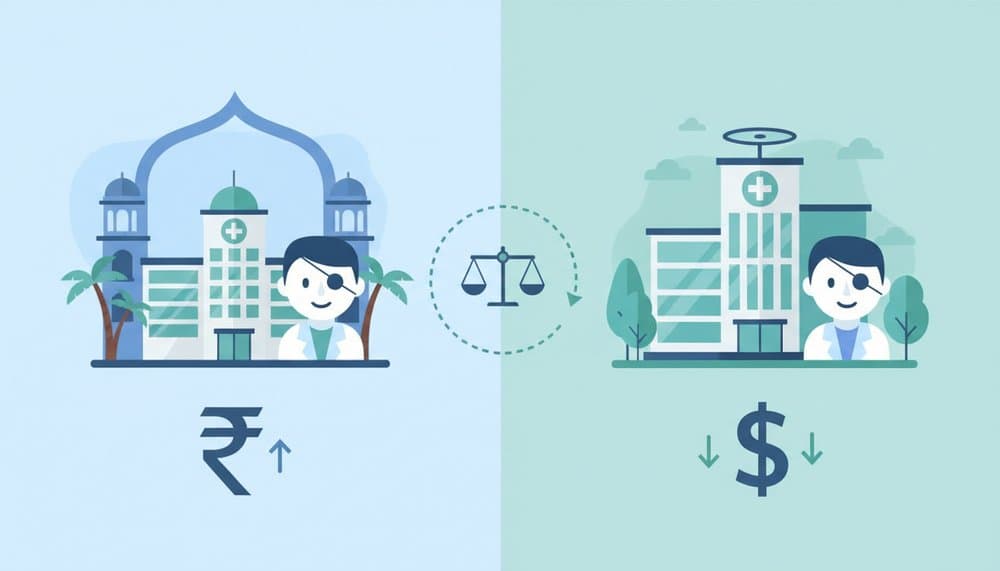
The most significant factor driving medical tourism for cataract surgery is the stark difference in cost. The financial savings of having the procedure in India can be substantial, even after accounting for travel and accommodation.
What Drives the Cost?
Several key factors influence the final bill for cataract surgery:
- Surgical Technique: Modern cataract surgery primarily uses Phacoemulsification, a minimally invasive ultrasound technique. A more advanced, blade-free option is Femtosecond Laser-Assisted Cataract Surgery (FLACS), which offers enhanced precision but at a higher cost.
- Intraocular Lens (IOL) Type: This is the biggest variable. The choice ranges from standard Monofocal lenses to premium Multifocal, Trifocal, Toric (for astigmatism), and Extended Depth of Focus (EDOF) lenses that can significantly reduce or eliminate the need for glasses post-surgery.
- Hospital and Surgeon: Costs vary based on the hospital's infrastructure (government, private, or premium super-speciality), the surgeon's experience, and the city where the procedure is performed.
- Insurance Coverage: The extent of coverage provided by private insurance, Medicare (in the US), or the NHS (in the UK) dramatically affects out-of-pocket expenses.
Here is a detailed breakdown of the estimated costs per eye in 2026:
Cataract Surgery Cost Comparison (per eye) - USA vs. UK vs. India (2026 Estimates)
Service/Lens Type — USA (USD) — UK (GBP) — India (INR) — India (USD Equivalent)
Uninsured/Self-Pay
Standard Phaco with Monofocal IOL — $3,000 - $7,000 — £2,000 - £3,500 — ₹25,000 - ₹45,000 — $300 - $540
Laser-Assisted (FLACS) with Monofocal IOL — $4,000 - $6,000 — Included in premium packages — ₹75,000 - ₹95,000 — $900 - $1,140
Premium Lens Upgrade (Out-of-Pocket)
Toric IOL (for Astigmatism) — +$1,000 - $2,500 — +£300 - £500 — ₹30,000 - ₹70,000 — $360 - $840
Multifocal/Trifocal IOL — +$2,000 - $4,000 — £3,500 - £5,000+ (total) — ₹35,000 - ₹90,000 — $420 - $1,080
EDOF IOL — +$3,000 - $4,500 — £3,796 (total) — ₹35,000 - ₹80,000 — $420 - $960
Insured Patients (Typical Out-of-Pocket)
USA (Medicare Part B) — ~$400 - $880 (after deductible) — N/A — N/A — N/A
USA (Private Insurance - PPO) — ~$2,500 — N/A — N/A — N/A
UK (NHS) — N/A — £0 (with long waiting times) — N/A — N/A
India (Private Insurance) — Coverage often capped at ₹25,000 - ₹40,000 for standard surgery — N/A — Patient pays premium lens difference — Patient pays premium lens difference
Note: USD to INR conversion is based on an approximate rate of 1 USD = 83 INR. This is for illustrative purposes and subject to change. Costs in India can be even lower in government or charitable hospitals.
Deep Dive into Lens (IOL) Options and Costs
The choice of IOL is a critical decision that impacts both your final vision and the total cost. Here’s a breakdown of the most common types available across all three countries.
- Monofocal Lenses: These are the standard and most affordable option. They provide clear vision at a single focal point, usually set for distance. Patients will typically require reading glasses for near tasks. In the US and UK, this is the lens covered by standard insurance and the NHS. In India, a standard monofocal lens surgery can cost as little as ₹15,000 - ₹20,000.
- Toric Lenses: Designed specifically to correct pre-existing astigmatism, these lenses provide clearer vision by correcting the irregular shape of the cornea. They are considered a premium option, and patients usually pay the additional cost out-of-pocket. In India, the cost for a toric lens can range from ₹30,000 to ₹70,000.
- Multifocal and Trifocal Lenses: These advanced lenses are designed with multiple focal zones to provide clear vision at near, intermediate, and far distances, significantly reducing or eliminating the need for glasses. They represent a significant upgrade and are a primary reason patients opt for private surgery. In India, these lenses can cost between ₹35,000 and ₹90,000.
- Extended Depth of Focus (EDOF) Lenses: A newer class of premium IOLs, EDOF lenses create a continuous range of vision from distance to intermediate (computer-use) ranges. They are known to cause fewer issues with glare and halos at night compared to some multifocal designs, making them a popular choice. The cost in India for EDOF lenses ranges from ₹35,000 to ₹80,000.
Cost of IOLs in India: Indian vs. Imported Brands
India's competitive pricing is also due to the availability of high-quality, locally manufactured IOLs alongside international brands.
IOL Type — Indian Brand (Approx. Cost in INR) — Imported Brand (Approx. Cost in INR)
Monofocal (Aspheric) — ₹16,000 — ₹28,000 (Hydrophobic)
Toric Monofocal — ₹35,000 — ₹40,000
Multifocal — ₹30,000 — ₹50,000
Toric Multifocal — ₹60,000 — ₹90,000
Trifocal — ~₹75,000 — ~₹75,000+
EDOF — ₹30,000 - ₹60,000 — ₹40,000 - ₹60,000+
Note: These are lens-only costs and the final bill will include surgeon fees, hospital charges, and taxes.
The Patient Journey: Navigating the System in Each Country
United States: For those with Medicare Part B, standard cataract surgery is covered once it's deemed medically necessary. Patients are typically responsible for 20% of the Medicare-approved amount after meeting their annual deductible, which can be around $400-$880 per eye. Premium lenses and laser-assisted surgery are not covered, and patients must pay the difference out-of-pocket, which can add thousands of dollars to the cost. For those without insurance, the costs are significantly higher, starting from around $3,000 per eye for a basic procedure.
United Kingdom: The National Health Service (NHS) provides cataract surgery with a monofocal lens free of charge. However, the primary drawback is the waiting time. While the official target is 18 weeks from referral to treatment, many patients wait much longer, sometimes 6 to 12 months. This delay can significantly impact quality of life. As a result, many opt for private surgery, where costs for a standard procedure start around £2,000 - £3,500 per eye and can exceed £5,000 for premium lenses.
India (Especially for NRIs): India offers a unique combination of speed, affordability, and quality. For an NRI, the process is streamlined for medical tourism.
- Initial Planning (3-6 months prior): It's advisable to have an initial eye evaluation in your country of residence. You can then research and select a reputable Indian hospital and surgeon. Many top hospitals offer virtual consultations.
- Arrival and Pre-Operative Assessment: Upon arrival in India, a comprehensive evaluation is conducted. This includes pre-operative tests like biometry (for IOL power calculation), a retina scan, and corneal topography, which may cost between ₹3,500 and ₹8,000.
- Surgery: The surgery is typically a quick outpatient procedure, often performed within a few days of the assessment.
- Post-Operative Care and Travel: A follow-up appointment is usually scheduled within 24-48 hours. Most surgeons advise waiting at least a week before flying, especially for long-haul flights, to ensure the eye is healing properly and to manage post-operative care. The total stay in India required is usually around 7-10 days.
Hospital and Surgeon Selection: A Framework for Your Decision
Choosing the right facility and surgeon is paramount to a successful outcome, regardless of the country.
Criteria for Selecting a Hospital/Surgeon:
- Accreditation: In India, look for hospitals with NABH (National Accreditation Board for Hospitals & Healthcare Providers) or JCI (Joint Commission International) accreditation. These certifications ensure adherence to high standards of safety and quality.
- Technology: Inquire about the technology used. Does the hospital offer modern techniques like FLACS, Micro-Incision Cataract Surgery (MICS), and advanced diagnostic tools?
- Surgeon's Credentials and Experience: Verify the surgeon's qualifications (MS/DNB in Ophthalmology) and look for fellowship training in cataract surgery. Ask about their surgical volume—a high-volume surgeon often has more refined skills.
- IOL Options: Ensure the hospital offers a wide range of IOLs, including both Indian and imported premium lenses, to suit your specific visual needs and budget.
- Transparency in Pricing: A reputable hospital will provide a detailed and transparent cost breakdown, including what is and isn't covered in a package.
- Patient Reviews and Testimonials: Lo
Top Anesthesiologist doctors in Lucknow on Zospital
Verified specialists you can book in minutes.
- Book appointment

Dr. Sanni Deyol Gautam
Anesthesiologist
Lucknow
4.8 - Book appointment

Dr Karanvir Singh Sidhu
Anesthesiologist
Lucknow
4.8 - Book appointment

Dr Harpreet Kaur
Anesthesiologist
Lucknow
4.8 - Book appointment

Dr. Akshat Trivedi
Anesthesiologist
Lucknow
4.5 - Book appointment
Aveline Pascual Jerome, MD
Anesthesiologist
Ajmer
5 - Book appointment
Dr. Vivek Kumar Sharma - Laser & Advanced Laparoscopy Surgeon In Ajmer
Anesthesiologist
Ajmer
4.7

“Your Health, Our Priority. Your Voice, Our Guide”
Dr. Nikhil Singh
Anaesthesia, MBBS, MD
Private hospitals in Lucknow on Zospital
Prefer a private option? These hospitals in Lucknow list their doctors and take bookings.
- Paarth Eye Hospital & Retina Centre
- Urmila Devi Memorial Hospital- Child Specialist Hospital in Lucknow | Pediatrician hospital
- SPARSH CHILDREN'S HOSPITAL & VACCINATION CENTER | Child Hospital in Raebareli Road Lucknow | Dr. Akhilesh Pandey |
Related Articles
Cataract Surgery Cost in India vs. USA, UK, and Australia
A detailed cost comparison of cataract surgery in India's private and government sectors versus costs for uninsured and insured patients in the US, UK, and Australia.
Cataract Surgery Cost in Lucknow: Complete Price Guide (2026)
Compare government vs private hospital rates for cataract surgery in Lucknow. Get complete pricing, insurance coverage, and cost-saving tips.

Cataract Surgery Hidden Charges: Tests, Medicines and Follow-Up
A simple patient guide to cataract surgery hidden charges: tests, medicines and follow-up, including documents, costs and questions to ask.

Written by Dr. Nikhil Singh
Anaesthesia, MBBS, MD
Last reviewed: 24 August 2026
Medical Disclaimer
The content provided on Zospital is for general informational and educational purposes only. It is not intended as a substitute for professional medical advice, diagnosis, or treatment. Always seek the advice of your physician or other qualified healthcare provider with any questions you may have regarding a medical condition. Never disregard professional medical advice or delay in seeking it because of something you have read on this website. If you think you may have a medical emergency, call your doctor or emergency services immediately.
Are you a doctor or run a clinic or hospital?
Patients across India are searching Zospital right now. Get a free profile with reviews, timings and direct WhatsApp bookings.