Remote Patient Monitoring NRI India
Medically reviewed by Dr.Nikhil Singh, Anaesthesia, MBBS, MD
Last reviewed: 17 Aug 2026
A Comprehensive Guide to Remote Patient Monitoring in India for NRIs
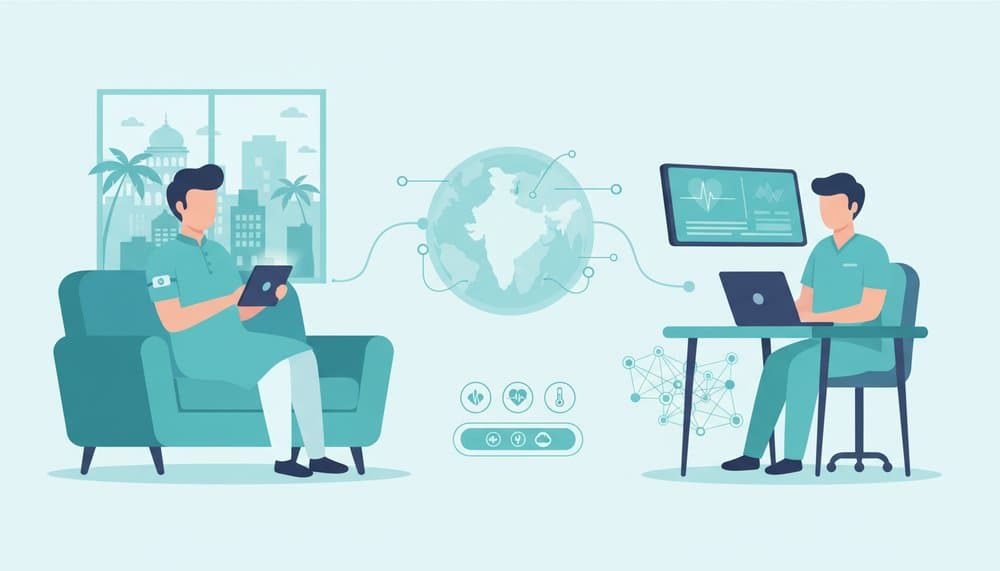
As a Non-Resident Indian (NRI), managing chronic health conditions or the well-being of elderly parents back in India can be a significant source of stress. The geographical distance often creates barriers to timely medical intervention and continuous care. However, the rapid advancements in digital healthcare in India have paved the way for a powerful solution: Remote Patient Monitoring (RPM). This guide provides a detailed overview of RPM devices and services in India, specifically tailored for NRIs, covering everything from available technologies and platform comparisons to costs and practical step-by-step guidance.
What is Remote Patient Monitoring?
Remote Patient Monitoring (RPM) is a healthcare delivery method that utilizes technology to monitor patient health outside of a traditional clinical setting, such as in the comfort of their own home. It involves the use of connected electronic devices that collect and transmit a patient's physiological data to their healthcare provider in real-time. This continuous stream of information allows doctors to track chronic conditions, detect early warning signs of complications, and provide timely interventions, all without the need for frequent in-person visits.
The Transformative Benefits of RPM for NRIs and their Families
For NRIs, RPM offers a paradigm shift in managing the health of their loved ones in India. The key benefits include:
- Improved Health Outcomes and Proactive Care: Continuous monitoring of vital signs allows for the early detection of potential health issues, enabling doctors to intervene before a condition worsens and potentially preventing hospitalizations. This is particularly crucial for managing chronic diseases like diabetes, hypertension, and heart conditions.
- Enhanced Peace of Mind: For NRIs living thousands of miles away, having access to real-time health data of their parents or family members provides immense reassurance. Knowing that a medical team is continuously overseeing their health can significantly reduce anxiety.
- Greater Patient Engagement and Empowerment: When patients can see their own health data, they become more involved and proactive in managing their conditions. RPM systems often include reminders for medication and lifestyle adjustments, which can improve adherence to treatment plans.
- Reduced Healthcare Costs: By enabling early interventions and reducing the need for emergency room visits and hospital readmissions, RPM can lead to significant long-term cost savings.
- Bridging the Geographical Divide: RPM, integrated with telemedicine platforms, allows NRIs to be actively involved in their parents' healthcare. Many platforms allow family members to join teleconsultations, ensuring they are part of the decision-making process.
Available Remote Patient Monitoring Devices in India
The Indian market offers a growing range of RPM devices that can be integrated with telemedicine platforms. These devices are often user-friendly and designed for home use.
Blood Pressure Monitors
Digital blood pressure monitors are essential for managing hypertension. Many models available in India are now "smart" devices that can automatically sync data with a mobile app.
- Key Features to Look For:
- Automatic, digital display: For ease of use.
- Bluetooth connectivity: To sync with a smartphone app.
- Memory function: To store past readings.
- Irregular heartbeat detection: An important feature for cardiac patients.
- Multiple user profiles: If more than one person will be using the device.
- Popular Brands in India: Omron, Dr. Morepen, AccuSure, Beurer, and Dr. Trust.
Glucose Monitors
For individuals with diabetes, regular blood glucose monitoring is critical. The technology in this space has evolved from traditional glucometers to Continuous Glucose Monitors (CGMs).
- Types of Glucose Monitors:
- Blood Glucose Meters (Glucometers): These require a small blood sample from a finger-prick to measure blood sugar levels. Many modern glucometers have Bluetooth capabilities to sync with apps.
- Continuous Glucose Monitors (CGMs): These are wearable sensors that continuously track glucose levels throughout the day and night, providing real-time data and trends without the need for frequent finger-pricks. They can send alerts for high or low glucose levels.
- Popular Brands in India:
- Glucometers: Accu-Chek, OneTouch, Dr. Morepen, BeatO.
- CGMs: FreeStyle Libre, Ultrahuman M1, GoodFlip.
Wearables with Doctor Integration
Smartwatches and other wearable devices have become increasingly sophisticated, offering a range of health tracking features. While many consumer-grade wearables track metrics like heart rate, sleep, and activity levels, a new category of clinical-grade wearables is emerging with a focus on medical accuracy and integration with healthcare platforms.
- Key Features for Health Monitoring:
- ECG (Electrocardiogram): To detect atrial fibrillation and other heart rhythm irregularities.
- SpO2 (Blood Oxygen Saturation): To monitor respiratory health.
- Heart Rate Variability (HRV): An indicator of stress and recovery.
- Fall Detection: An essential feature for elderly users.
- Sleep Tracking: To assess sleep quality and patterns.
- Platforms and Devices with Doctor Integration:
- Apollo Hospitals' Enhanced Connected Care: Utilizes biosensors to track vital signs like ECG, blood pressure, and SpO2, with real-time data transmitted to a platform monitored by medical professionals.
- iLive Connect: An AI-powered system with a wearable biosensor patch and wristband that tracks multiple vitals and alerts a doctor-led command center in case of any deviations.
- Consumer Wearables: While not always directly integrated with hospital systems, data from popular wearables like Apple Watch, Fitbit, and Garmin can often be shared with doctors during teleconsultations to provide a more holistic view of a patient's health.
How Doctors in India Monitor Patients Remotely
The process of remote patient monitoring typically follows these steps:
- Device Setup and Data Collection: The patient uses the RPM devices at home as instructed. These devices automatically collect data on vital signs.
- Data Transmission: The collected data is securely transmitted via a smartphone app or a dedicated hub to a cloud-based platform.
- Data Analysis and Monitoring: A team of healthcare professionals (doctors, nurses, or care coordinators) accesses this data through a central dashboard. Many platforms use AI-powered algorithms to analyze the data, identify trends, and flag any readings that fall outside of the pre-set parameters for that patient.
- Alerts and Intervention: If a patient's data indicates a potential issue, the system generates an alert for the medical team. A healthcare professional will then follow up with the patient, which could involve a phone call, a video consultation, medication adjustment, or, if necessary, advising a visit to a hospital.
- Regular Reports and Communication: Patients and their families often have access to a dashboard to view their health trends. Regular reports can be generated and discussed during scheduled teleconsultations.
Leading Telemedicine Platforms with RPM Integration in India
Several major healthcare providers and digital health startups in India offer integrated RPM services.
Platform — RPM Services Offered — Key Features for NRIs
Apollo 24/7 & Apollo Homecare — Offers integrated RPM solutions for chronic conditions, post-operative care, and elderly care. They have their own biosensors and integrate with other devices. — Well-established brand, comprehensive services, option for family members to join consultations.
— Provides teleconsultations and allows for the integration of health data from various sources. — Wide network of doctors, user-friendly app, online prescription services.
Tata 1mg — A comprehensive platform offering teleconsultations, online pharmacy, and diagnostic services. They are also involved in providing affordable medicines in rural areas. — Integrated healthcare ecosystem, reliable brand, medicine delivery services.
MFine — Connects users with doctors for online consultations and supports the sharing of health data. — AI-powered platform, access to a wide range of specialists.
Cognota Healthcare — Focuses on providing RPM technology to hospitals and clinics, including devices for blood glucose, blood pressure, and SpO2 monitoring. — B2B focus, but their technology powers many hospital-led RPM programs.
MedTel Healthcare — Offers RPM, telemedicine, and teleclinic solutions, with a focus on connected devices like portable ECGs and glucometers. — Aims to improve healthcare accessibility, particularly in rural areas.
Cost of RPM Devices and Services in India
The cost of RPM can be broken down into two main components: the one-time cost of the devices and the recurring cost of the monitoring service.
Cost of RPM Devices (One-Time Purchase)
Device Type — Price Range (in INR) — Notes
Digital Blood Pressure Monitor — ₹1,000 - ₹3,500 — Bluetooth-enabled models are at the higher end of this range.
Blood Glucose Monitor (Glucometer) — ₹500 - ₹2,000 — The ongoing cost of test strips is a significant factor.
Continuous Glucose Monitor (CGM) — ₹4,000 - ₹8,000 per sensor — Sensors typically last for 14 days. Some systems have a reusable transmitter.
Wearable Health Trackers — ₹3,000 - ₹45,000+ — Price varies widely based on brand and features (e.g., ECG, SpO2).
|
Written by
Top Anesthesiologist doctors in Lucknow on Zospital
Verified specialists you can book in minutes.
- Book appointment

Dr. Sanni Deyol Gautam
Anesthesiologist
Lucknow
4.8 - Book appointment

Dr Karanvir Singh Sidhu
Anesthesiologist
Lucknow
4.8 - Book appointment

Dr Harpreet Kaur
Anesthesiologist
Lucknow
4.8 - Book appointment

Dr. Akshat Trivedi
Anesthesiologist
Lucknow
4.5 - Book appointment
Dr. Praful Srivastava
Anesthesiologist
4.8 - Book appointment

Dr. Mohd. Ruheel Khan
Anesthesiologist
Faizabad

“Your Health, Our Priority. Your Voice, Our Guide”
Dr.Nikhil Singh
Anaesthesia, MBBS, MD
Private hospitals in Lucknow on Zospital
Prefer a private option? These hospitals in Lucknow list their doctors and take bookings.
See all hospitals in LucknowRelated Articles
R. G. Kar Medical College and Hospital, Kolkata: OPD Appointment and Costs
A detailed guide on how to get an OPD appointment, registration process, treatment costs, and financial assistance available at R. G. Kar Medical College and Hospital in Kolkata.
RIMS Imphal: OPD Appointment, Registration, and Fees
A detailed guide on how to get an appointment, OPD registration process, consultation timings, treatment costs, and financial assistance schemes available at the Regional Institute of Medical Sciences (RIMS), Imphal.
OPD Appointment Guide: Dr. Ram Manohar Lohia Institute of Medical Sciences (RMLIMS), Lucknow
A factual patient guide covering the OPD appointment process, registration timings, departments, costs, and government health scheme coverage at Dr. Ram Manohar Lohia Institute of Medical Sciences (RMLIMS), Lucknow, Uttar Pradesh.

Written by Dr.Nikhil Singh
Anaesthesia, MBBS, MD
Last reviewed: 17 August 2026
Medical Disclaimer
The content provided on Zospital is for general informational and educational purposes only. It is not intended as a substitute for professional medical advice, diagnosis, or treatment. Always seek the advice of your physician or other qualified healthcare provider with any questions you may have regarding a medical condition. Never disregard professional medical advice or delay in seeking it because of something you have read on this website. If you think you may have a medical emergency, call your doctor or emergency services immediately.
Are you a doctor or run a clinic or hospital?
Patients across India are searching Zospital right now. Get a free profile with reviews, timings and direct WhatsApp bookings.