Prostate Hyperplasia Surgery Cost in India: Financial Overview
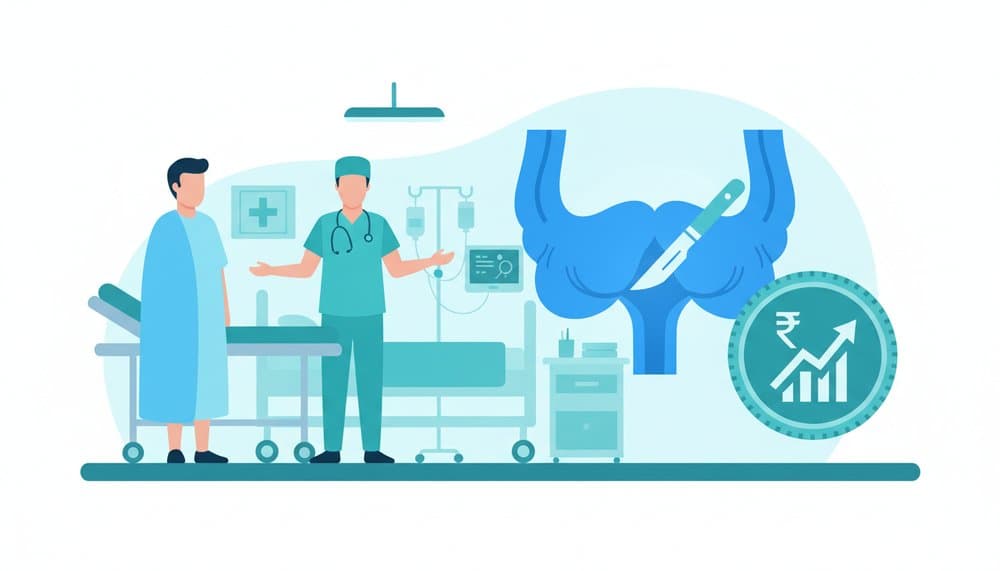
Medically reviewed by Dr. Nikhil Singh, Anaesthesia, MBBS, MD
Last reviewed: 24 Aug 2026
A Comprehensive Guide to Benign Prostatic Hyperplasia (BPH) Surgery Costs in India
For countless men approaching their senior years, both in India and abroad, an enlarged prostate, or Benign Prostatic Hyperplasia (BPH), becomes a fact of life. This non-cancerous growth of the prostate gland can lead to uncomfortable and disruptive urinary symptoms, such as a frequent urge to urinate, a weak stream, and incomplete bladder emptying. When medication and lifestyle changes no longer provide relief, surgery becomes the most effective long-term solution.
This guide serves as a detailed resource for patients and their families, particularly Indian residents and Non-Resident Indian (NRI) expats, to navigate the landscape of BPH surgery in India. We will delve into the costs of the most common surgical procedures, provide frameworks for making informed decisions, and set clear expectations for recovery.
Understanding the Financial Aspect: BPH Surgery Costs in India
The cost of BPH surgery in India is significantly more affordable than in Western countries like the US or UK, without compromising on the quality of care, especially at accredited facilities. However, the final bill can vary widely based on several factors.
Key Factors Influencing Surgery Cost:
- Type of Surgery: The technology used is a primary cost driver. Advanced laser procedures are typically more expensive than traditional surgery.
- Hospital Choice: Costs at a premier private hospital in a metro city will be substantially higher than at a government hospital or a facility in a Tier-2 city.
- Surgeon's Expertise: The fees for a highly experienced urologist with a strong track record will be higher.
- Room Category: The choice of a private room versus a shared ward significantly impacts the overall package cost.
- Length of Hospital Stay: Longer stays due to the type of surgery or complications will increase the cost.
- Pre-operative Diagnostics: Essential tests before surgery add to the total expense.
- Post-operative Care: The cost of medications, follow-up consultations, and management of any complications are additional expenses.
Pre-Surgery Diagnostic Costs
Before recommending surgery, your urologist will perform a thorough evaluation. The approximate costs for these essential diagnostic tests are:
- Prostate-Specific Antigen (PSA) Blood Test: ₹800 to ₹1,500
- Urine Test (Urinalysis): ₹500 to ₹1,500
- Transrectal Ultrasound (TRUS): ₹1,500 to ₹2,000
- Urodynamic Test: ₹7,000 to ₹9,000
Comparative Cost of BPH Surgical Procedures
Below are estimated cost ranges for the three main types of BPH surgery. These figures are indicative and represent the surgical package, which often includes the surgeon's fee, anesthesia, hospital stay for a specified period, and routine medications. Always get a detailed, itemized quote from the hospital in writing.
Surgical Procedure — Average Cost Range (INR) — Minimum Cost (INR) — Maximum Cost (INR)
TURP (Transurethral Resection of the Prostate) — ₹60,000 - ₹1,00,000 — ₹55,000 — ₹1,20,000
Laser Therapy (HoLEP, GreenLight PVP) — ₹1,00,000 - ₹1,50,000 — ₹80,000 — ₹1,60,000
Open Prostatectomy — ₹80,000 - ₹1,30,000 — ₹70,000 — ₹1,60,000
Note: These prices are estimates as of 2026 and can vary. Robotic-assisted procedures are also available and are the most expensive, potentially costing ₹2,80,000 or more.
Cost Variation Across Major Indian Cities
Metropolitan areas with advanced healthcare infrastructure tend to have higher costs.
City — TURP (Approx. Average Cost) — Laser Surgery (Approx. Average Cost)
Delhi — ₹87,500 — ₹1,20,000
Mumbai — ₹87,500 — ₹1,20,000
Bangalore — ₹87,500 — ₹1,20,000
Chennai — ₹87,500 — ₹1,20,000
Hyderabad — ₹87,500 — ₹1,20,000
Pune — ₹87,500 — ₹1,20,000
Source:, 2026.
A Closer Look at BPH Surgery Options
The choice of surgery is a clinical decision made by you and your urologist, based on your specific condition.
1. Transurethral Resection of the Prostate (TURP)
The Procedure: For decades, TURP has been the gold standard for BPH surgery. The surgeon inserts a thin instrument called a resectoscope through the urethra. An electrical loop at the end of the scope cuts away excess prostate tissue piece by piece, clearing the channel for urine to flow.
Best For: Men with small to moderately enlarged prostates. It is widely available and generally more affordable than laser options.
2. Laser Therapy (HoLEP and GreenLight PVP)
The Procedure: These are modern, minimally invasive techniques that use laser energy to remove obstructing prostate tissue.
- Holmium Laser Enucleation of the Prostate (HoLEP): A high-powered laser is used to "enucleate" or peel away large sections of the prostate tissue from its outer capsule. This makes it highly effective for prostates of any size.
- Photoselective Vaporization of the Prostate (PVP or GreenLight): This method uses a laser to heat and vaporize the prostate tissue, creating an open channel.
Best For: Laser procedures are particularly advantageous for men on blood thinners due to minimal bleeding. HoLEP is considered highly effective for very large prostates. These methods often involve a shorter hospital stay and quicker recovery.
3. Open Prostatectomy
The Procedure: This is a traditional surgical approach where the surgeon makes an incision in the lower abdomen to access and remove the inner part of the prostate gland.
Best For: This surgery is now reserved almost exclusively for men with extremely large prostate glands or for cases with complications like large bladder stones, where minimally invasive approaches are not feasible.
Making the Right Choice: A Decision-Making Framework
Choosing the right surgery involves balancing effectiveness, recovery, and cost. Use this framework to guide your discussion with your urologist.
Factor — TURP — Laser Therapy (HoLEP/GreenLight) — Open Prostatectomy
Prostate Size — Best for small to moderate size. — Effective for all sizes; HoLEP is excellent for very large prostates. — Reserved for very large prostates or complex cases.
Bleeding Risk — Moderate bleeding risk. — Low bleeding risk; ideal for patients on blood thinners. — Higher bleeding risk.
Hospital Stay — 1 to 3 days. — 1 to 2 days. — Longer stay, typically 3 to 5 days or more.
Catheter Time — Usually a few days post-surgery. — Often shorter duration or removed sooner. — Longer duration.
Recovery Speed — Slower; return to normal activities in 4-6 weeks. — Faster; return to non-strenuous work in 1-2 weeks. — Slowest; requires several weeks of restricted activity.
Cost — Most affordable option. — Higher cost due to specialized equipment. — Moderate to high cost, depending on hospital stay.
Long-Term Efficacy — Excellent, long-lasting results. — Excellent, durable results. — Most durable results for very large glands.
Selecting the Right Hospital and Surgeon
For patients, especially NRIs traveling to India for care, choosing the right facility is as important as choosing the right procedure.
Hospital Selection Criteria:
- Accreditation: Prioritize hospitals with national (NABH) or international (JCI) accreditation. These certifications ensure adherence to high standards of safety and quality.
- Urology Department & Case Volume: Choose a hospital with a dedicated urology center that performs a high volume of prostate surgeries. High volume is often linked to better outcomes.
- Surgeon's Experience: Research the surgeon. Look for a board-certified urologist with extensive experience in the specific procedure you are considering. Don't hesitate to ask about their personal case volume.
- Technology and Infrastructure: Ensure the hospital is equipped with modern technology, such as the latest laser systems (Holmium, GreenLight) and has robust critical care (ICU) backup.
- International Patient Services: For NRIs, a hospital with a dedicated international patient desk is invaluable. They can assist with visas, accommodation, airport transfers, and communication, ensuring a seamless experience.
- Transparent Pricing: A reputable hospital will provide a detailed and itemized cost estimate upfront, clearly stating inclusions and exclusions.
The Road to Recovery: Timelines and Expectations
Recovery varies for each person and procedure, but a general timeline can help you plan.
Recovery after TURP
- Hospital Stay: 1 to 3 days.
- Catheter: A urinary catheter is typically in place for a few days after surgery.
- At Home: You may see blood in your urine intermittently for several weeks. It's crucial to stay hydrated. Avoid strenuous activity, heavy lifting (>5kg), and driving for at least 2-3 weeks. A significant bleed can sometimes occur 10-14 days post-op as the internal scab heals.
- Full Recovery: Most men feel they are getting back to normal within 4 to 6 weeks, though complete healing can take up to 3 months.
Recovery after Laser Surgery (HoLEP/GreenLight)
- Hospital Stay: Usually shorter, around 1 to 2 days.
- Catheter: May be removed before discharge or within a day or two.
- At Home: Recovery is generally faster with less bleeding. You can often return to desk work and light activities within one to two weeks. However, you should still avoid strenuous exercise for at least two weeks and activities like cycling for six weeks.
- Full Recovery: While initial recovery is quick, the internal healing process takes 8 to 12 weeks.
Recovery after Open Prostatectomy
- Hospital Stay: The longest of the three, often 3-5 days or more.
- **
Written by
Top Anesthesiologist doctors in Lucknow on Zospital
Verified specialists you can book in minutes.
- Book appointment

Dr. Sanni Deyol Gautam
Anesthesiologist
Lucknow
4.8 - Book appointment

Dr Karanvir Singh Sidhu
Anesthesiologist
Lucknow
4.8 - Book appointment

Dr Harpreet Kaur
Anesthesiologist
Lucknow
4.8 - Book appointment

Dr. Akshat Trivedi
Anesthesiologist
Lucknow
4.5 - Book appointment
Aveline Pascual Jerome, MD
Anesthesiologist
Ajmer
5 - Book appointment
Dr. Vivek Kumar Sharma - Laser & Advanced Laparoscopy Surgeon In Ajmer
Anesthesiologist
Ajmer
4.7

“Your Health, Our Priority. Your Voice, Our Guide”
Dr. Nikhil Singh
Anaesthesia, MBBS, MD
Private hospitals in Lucknow on Zospital
Prefer a private option? These hospitals in Lucknow list their doctors and take bookings.
- Paarth Eye Hospital & Retina Centre
- Urmila Devi Memorial Hospital- Child Specialist Hospital in Lucknow | Pediatrician hospital
- SPARSH CHILDREN'S HOSPITAL & VACCINATION CENTER | Child Hospital in Raebareli Road Lucknow | Dr. Akhilesh Pandey |
Related Articles

Prostate Surgery Cost in India: TURP and Laser Price Guide
A practical guide to typical prostate surgery (TURP and laser) costs in private hospitals in India.

Prostate (TURP) Surgery Cost: CGHS vs Private
A cost comparison of TURP prostate surgery across CGHS and private hospitals.

Psychiatry & Mental Health Care Guide
This guide to psychiatry and mental health explains mental wellness as a spectrum, common conditions, treatment, and costs.
Written by Dr. Nikhil Singh
Anaesthesia, MBBS, MD
Last reviewed: 24 August 2026
Medical Disclaimer
The content provided on Zospital is for general informational and educational purposes only. It is not intended as a substitute for professional medical advice, diagnosis, or treatment. Always seek the advice of your physician or other qualified healthcare provider with any questions you may have regarding a medical condition. Never disregard professional medical advice or delay in seeking it because of something you have read on this website. If you think you may have a medical emergency, call your doctor or emergency services immediately.
Are you a doctor or run a clinic or hospital?
Patients across India are searching Zospital right now. Get a free profile with reviews, timings and direct WhatsApp bookings.